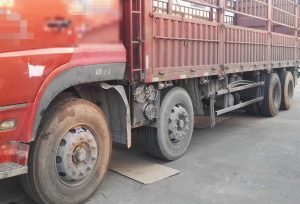
Baicheng’s traffic police detachment issued a notice on October 26 barring China-III and older heavy diesel trucks from the central urban area, effective November 3, 2026. The notice rests on the Air Pollution Prevention and Control Law, the Jilin provincial air regulations and the Road Traffic Safety Law, and frames the goal as cutting vehicle exhaust pollution and improving air quality in the city core.
A 24-hour ban, with industrial parks carved out
The restriction covers China-III and older heavy diesel trucks across the central urban area, explicitly excluding industrial parks. It applies 24 hours a day with no time-window exemption. Trucks needed for emergency repair, rescue or livelihood supply must apply in advance for a temporary permit and travel on designated routes at designated times.
Two penalties, applied in parallel
Enforcement runs on two tracks. Under Article 223 of the Ecological Environment Code, driving a vehicle that has failed its emissions inspection draws a 100 yuan fine; disregarding the prohibition sign draws a 200 yuan fine and one penalty point under the Road Traffic Safety Law and the points rules.
What this means for AIFILTECH customers
The notice regulates an emission standard, not measured emissions — China-III is the registered emission stage of the vehicle, a legal attribute of the model, and no retrofit turns a China-III truck into a China-IV one or restores its access to the city centre. For owners of these trucks the realistic options are replacement or routing through industrial parks and bypass roads. Selling “fit a purifier and drive back in” would mislead the customer and cross a compliance line, and that has to be said plainly in any fleet proposal. The vehicles still worth retrofitting are the China-IV and China-V trucks that keep running: the notice retains the 100 yuan penalty for failing an emissions test, and winter cold, short trips and constant stop-start are exactly the conditions that leave DPFs under-regenerated and SCR systems crystallised or clogged. A pre-winter inspection and cleaning pass costs far less than a scramble before the annual test. That is where components such as the AIFILTECH metal black smoke purifier earn their place — cutting visible black smoke so a test does not have to be repeated, not substituting for the legal emission-stage determination. As China-III trucks leave the city core, the capacity gap will be filled either by new vehicles or by running existing China-IV and China-V trucks harder, and the second route raises aftertreatment maintenance frequency — a cost worth writing into the winter maintenance plan now.