India’s Ministry of Road Transport and Highways published three draft BS-VII notifications in the Gazette of India in October 2026, amending Rule 115 of the Central Motor Vehicles Rules, 1989. Two cover commercial vehicles: G.S.R. 881(E) of October 12 for N1 light goods vehicles and G.S.R. 882(E) of October 13 for M2 and M3 buses and N2 and N3 trucks. A separate draft covers M1 passenger cars. Each category runs through three phases ending on April 1, 2035, and public comments are open for 30 days, so the text can still change.
Three timelines, one end date
Cars start on April 1, 2029, with later phases in 2031 and 2035. Light goods vehicles start on April 1, 2030, with phases in 2030, 2032 and 2035; from April 1, 2032, brake particle limits apply, set at 3 mg/km for battery-electric vehicles in the two lighter classes and 5 mg/km in the heaviest, against 7 and 11 mg/km for hybrids, fuel-cell and combustion vehicles. Buses and medium and heavy trucks start on April 1, 2031, with phases in 2031, 2033 and 2035; brake particle limits and C2/C3 tyre abrasion requirements will be notified separately.
Truck limits: 200 mg/kWh, aligned with Euro 7
Limits for buses and trucks are expressed per kilowatt-hour rather than per kilometre. On the laboratory cycles the draft sets NOx at 200 mg/kWh, PM at 8 mg/kWh, particle number at 600 billion/kWh, CO at 1,500 mg/kWh and ammonia at 60 mg/kWh; real-driving emissions allow 260 mg/kWh of NOx and 900 billion particles. The particle-counting threshold falls from 23 to 10 nanometres, bringing finer particles into the measurement regime. The package tracks Euro 7/VII.
In-service compliance moves into type approval
Vehicles must carry on-board monitoring that records actual emissions and flags exceedances at 2.5 times the limit. For buses and trucks the data must be readable through the OBD port from April 1, 2031, and available anonymously over the air from April 1, 2033. Owners get an Environmental Vehicle Passport covering fuel or energy consumption, battery health and pollutant emissions. Compliance is assessed over the vehicle’s life: 700,000 km or 12 years for the heaviest classes, and 160,000 km or eight years for N1, extendable to 200,000 km or ten years. Combustion vehicles with geofencing can seek BS-VII-G approval. Vehicles already on the road to BS-VI are not required to meet the new norms.
What this means for AIFILTECH customers
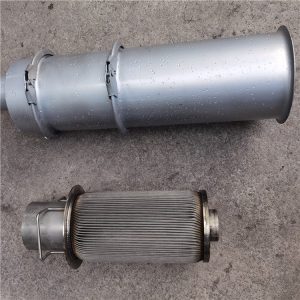
A 200 mg/kWh ceiling puts Indian heavy-truck aftertreatment on the same footing as Euro 7, so diesel engines, generator sets and non-road packages exported to India need to be re-checked against that table rather than against BS-VI data. The bigger shift is the 700,000 km, 12-year useful life combined with on-board monitoring: aftertreatment stops being a type-approval part and becomes a life-of-vehicle part, which pushes substrate blockage, cleaning intervals and backpressure into warranty terms and claims. On the installed base, the draft leaves in-service BS-VI vehicles untouched, so the repair and retrofit window for the many BS-IV and BS-VI diesel trucks on Indian roads stays open — the practical opening for cleanable, thermal-shock-resistant hardware such as the AIFILTECH metal black smoke purifier. For South Asian customers, writing substrate life, cleaning interval and a backpressure curve into the technical agreement will matter more than quoting a unit price.