Water-Washable Regenerative Exhaust Gas Purifier for Airport Vehicles

Purification rate 99%
Filter life Washable metal cores
Regeneration 1-minute water wash
Customisation Built to engine model

Product Introduction

The 6th-generation AIFILTECH water-washable regenerative metal black smoke purifier was developed through three years of dedicated R&D and is fully protected by independent intellectual property rights. With a purification efficiency of over 99%, it inherits all the strengths of previous generations — full emission compliance, 1-minute water-washing regeneration, long service life, durability, high cost performance and easy installation — and further adopts multi-stage filtration for highly long maintenance intervals. It was purpose-built for the strict reliability requirements of airport vehicles and their nearly continuous daily operation.

Detailed Overview

01 Product Introduction

Guangzhou TUOKAI Environmental Protection Technology Co., Ltd. was founded by professionals with over 20 years of experience in high-temperature flue gas treatment and diesel engine exhaust after-treatment, holds multiple independent intellectual property rights, and professionally supplies high-temperature flue gas (exhaust) treatment products and equipment for a wide range of applications.

The Water-Washable Regenerative Exhaust Gas Purifier for Airport Vehicles is a new-generation black smoke purifier developed by AIFILTECH on the basis of independent intellectual property. Its core is a TPS water-washable regenerative metal filter element (metal DPF, patent No. ZL 2018 1 0598975.7) made from special high-temperature-resistant, corrosion-resistant metal media through more than 30 processes. Particulate filtration efficiency reaches over 90%, regeneration by water washing takes about one minute, and the unit offers consistent emission compliance, no secondary pollutants, a long service life, high resistance to damage, good cost performance and simple installation. It is suitable for airport ground support equipment such as boarding bridges, baggage tractors and apron vehicles. Nearly 5,000 sets are in service across China.

Designed for the intensive duty and strict emission control of airport vehicles, the multi-stage filtration option significantly extends maintenance intervals to suit continuous airport rosters.

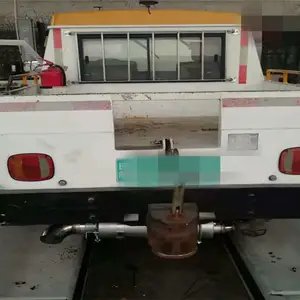
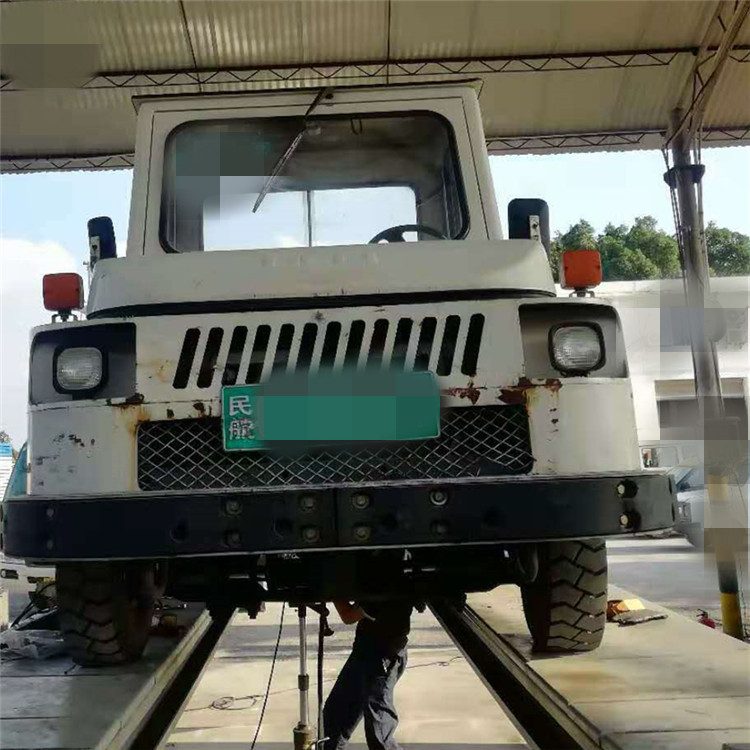
Working conditions: Airport ground support vehicles work intensively under strict emission control and often operate near terminal buildings, so particulate capture efficiency and reliability are critical.

Airport sweeper water-washable purifier

02 Working Principle

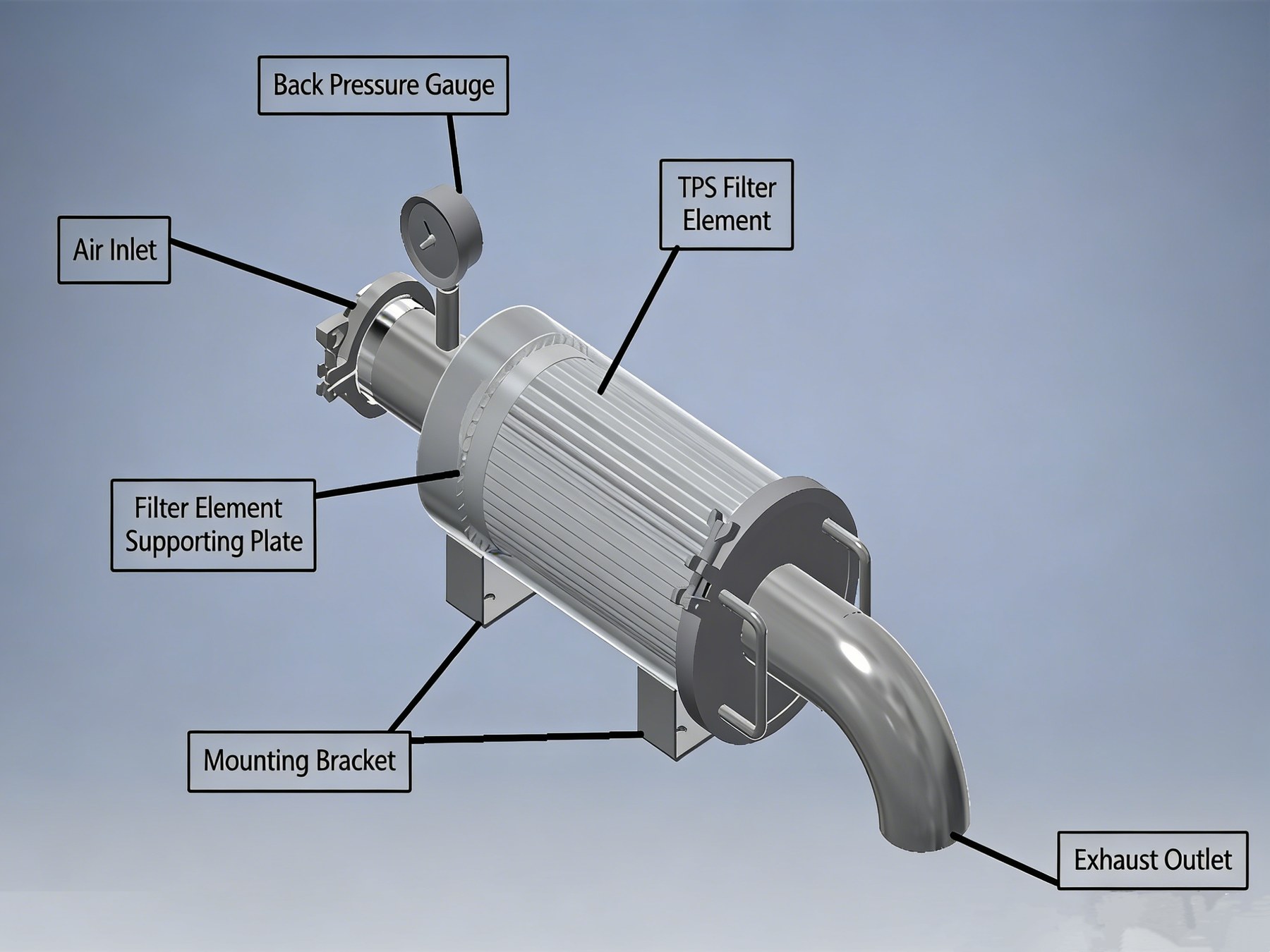
Exhaust gas emitted by diesel engines enters the air inlet of the AIFILTECH exhaust filtration system. The gas, laden with carbon particles, passes from the outside to the inside through the TPS filter element, where the particles are captured by the element wall and the clean gas is discharged into the atmosphere from the air outlet.

Hot exhaust enters the housing and passes through the outer surface of the core into the element body; black smoke and carbon particles are blocked on the outer surface, and the cleaned gas is collected through the core outlet and discharged from the exhaust port.

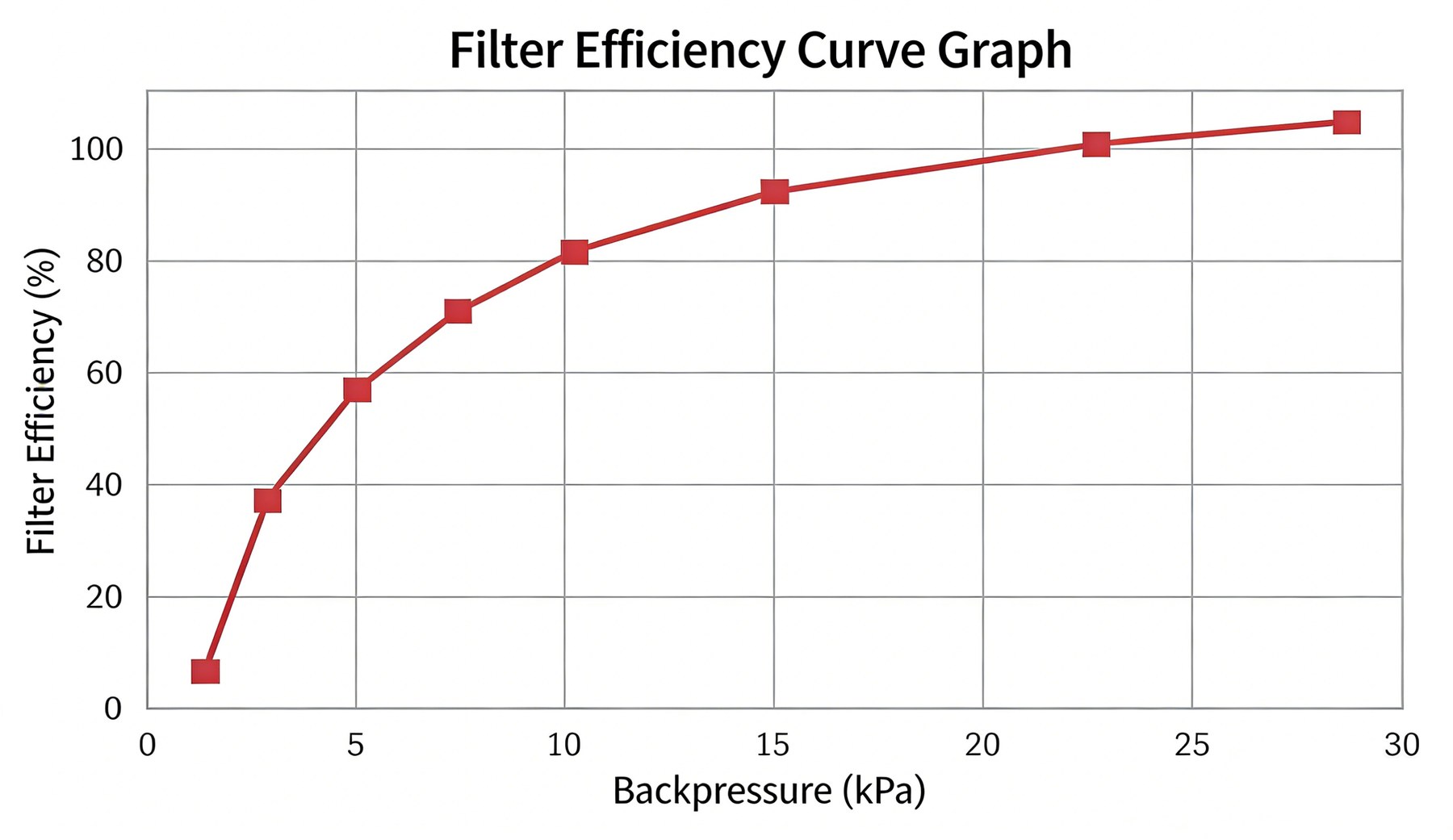
As the engine runs continuously, carbon particles accumulate on the outer surface of the core and system back pressure gradually rises. Once back pressure reaches the set value, the machine can be stopped, the clamp removed, the core pulled out and rinsed clean under a tap, then reinstalled into the housing and the clamp retightened for further use — a cycle that repeats. Initial back pressure is as low as 1 kPa, so normal engine operation is barely affected. The specially designed particulate trap offers high soot-holding capacity and long service intervals with low maintenance. When back pressure reaches the preset value (generally 25 kPa), an alarm can be set to remind the operator to regenerate the core.

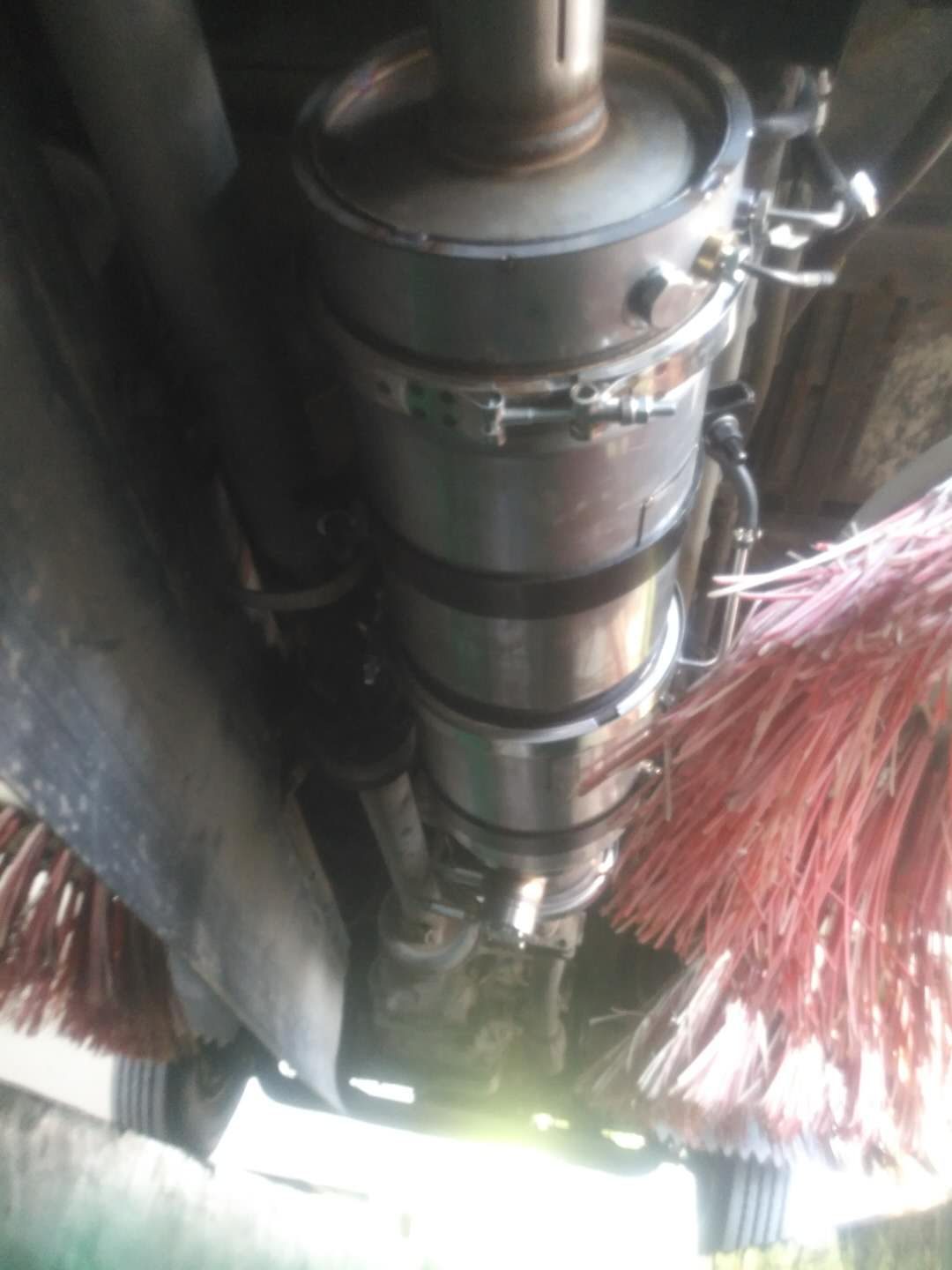
Where conditions are harsh, smoke density is high and maintenance intervals should be as long as possible, an optional multi-stage filtration system — primary + intermediate + high-efficiency — can be fitted. The primary stage uses a lower-precision high-temperature-resistant medium to capture large-diameter soot; the intermediate stage uses a higher-precision medium for medium-diameter soot; the final high-efficiency stage uses high-precision metal media for the finest soot. Three-stage filtration lets the exhaust meet emission standards while greatly extending maintenance and cleaning intervals. In an actual airport vehicle application, even with about four hours of continuous daily use, the unit ran for 30 consecutive days with back pressure kept below 15 kPa.

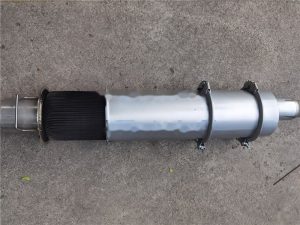
Exhaust purifier structure diagram (air inlet, TPS filter element, supporting plate, mounting bracket, exhaust outlet, back pressure gauge)

03 Product Advantages

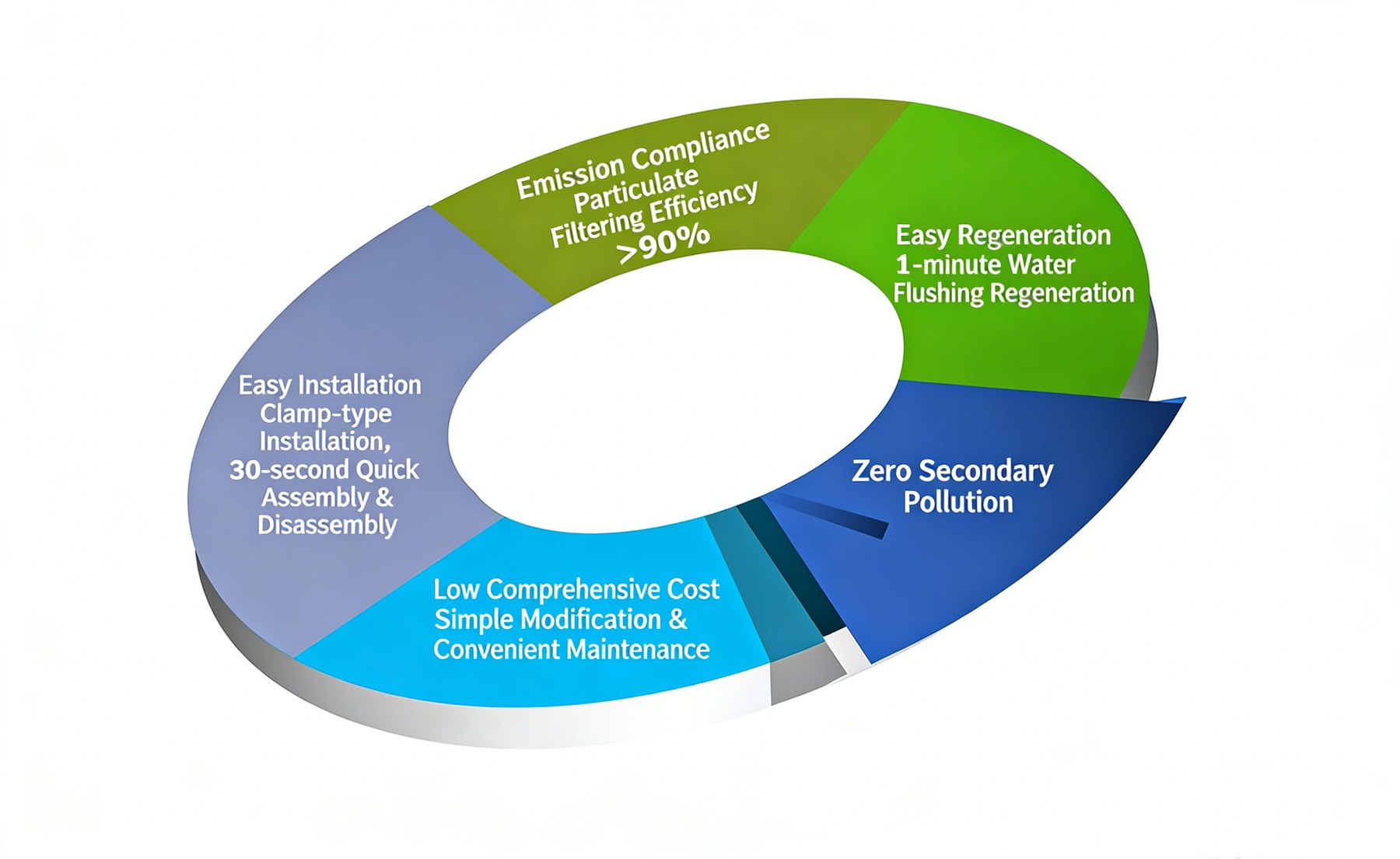
  • Emission standard compliance: particulate filtration efficiency over 90%, with a measured light absorption coefficient below 0.5 m⁻¹;
  • Easy regeneration: 1-minute water-washing regeneration, reusable without damage;
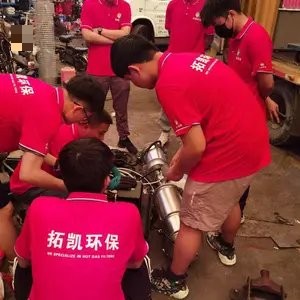
  • Easy installation: clamp-on design, 30-second quick disassembly and assembly;
  • No secondary pollutants;
  • Low comprehensive cost: simple retrofit and convenient maintenance;
  • The optional multi-stage filtration significantly extends maintenance intervals for continuous airport rosters and meets emission control requirements near terminal buildings.
  • The core is a washable metal structure: once removed, rinsing it under a tap restores filtration capacity — no factory return or high-temperature treatment, keeping maintenance simple and low.
  • An optional primary + intermediate + high-efficiency three-stage arrangement captures coarse, medium and fine soot progressively, meeting emission requirements while greatly extending service intervals.

Metal core versus ceramic DPF — a technical route comparison for selection reference: The metal core maintains particulate filtration efficiency above 90% even under high-density black smoke; it can be regenerated by water washing and reused within about one minute; being all-metal it is not easily damaged in transport, installation or operation, and the core is heat- and corrosion-resistant; its dimensions can be customised to the installation space for diesel engines of all power ratings, at roughly half the weight of an equivalent ceramic-core unit; overall operating cost is low and retrofitting is simple. (Glossary: DPF, short for Diesel Particulate Filter, is a particulate trap generally available in ceramic and metal versions. Regeneration refers to cleaning the DPF after it is clogged with PM and carbon particles to restore its filtration capacity.)

Particulate filtration efficiency curveAdvantages overview: high filtration efficiency, washable regeneration, easy installation, zero secondary pollution

04 Certifications & Application Cases

The product has passed tests by CMA, CAL, ILAC-MRA and CNAS accredited laboratories and obtained a qualified report, with a measured light absorption coefficient of less than 0.5 m⁻¹, meeting current emission standards.

Since the AIFILTECH water-washable regenerative metal purifier was successfully developed, the core product has accumulated nearly 5,000 sets of application cases in the after-treatment industry and has grown into a core equipment supplier for mainstream non-road diesel vehicle retrofit and purification in China. As early as 2018 the company took part in the non-road vehicle retrofit programme in Nanjing through its channels and now has nearly 1,000 successful cases in the Nanjing market, with users across the country. The product has been applied in demanding non-road scenarios such as Beijing Capital International Airport, Guangzhou Baiyun Airport, Xiamen Airport, Nanchang Airport and Nanning Airport, and is widely used at port terminals, in enterprise forklift fleets and on engineering machinery.

Typical applications: airport ground support equipment such as boarding bridges, baggage tractors and apron vehicles. The model is already in volume service in these applications, with selection calculation, installation guidance and commissioning support provided.

Where conditions are harsh, smoke density is high and maintenance intervals should be as long as possible, an optional multi-stage filtration system — primary + intermediate + high-efficiency — can be fitted. The primary stage uses a lower-precision high-temperature-resistant medium to capture large-diameter soot; the intermediate stage uses a higher-precision medium for medium-diameter soot; the final high-efficiency stage uses high-precision metal media for the finest soot. Three-stage filtration lets the exhaust meet emission standards while greatly extending maintenance and cleaning intervals. In an actual airport vehicle application, even with about four hours of continuous daily use, the unit ran for 30 consecutive days with back pressure kept below 15 kPa.
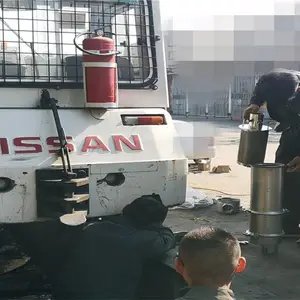
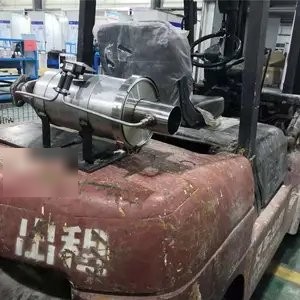
Airport terminal tractor exhaust purifier

Applications

Diesel generator sets Construction machinery Forklifts Marine auxiliary engines Mining equipment Engine test benches Emergency power trucks Tunnel construction Airports Port terminals Construction sites Municipal roads
Need the full technical data? Download the PDF datasheet for complete technical data, key figures and selection guidance.
Download Datasheet

All data above are obtained under specific test conditions; the actual solution must be engineered to site conditions. AIFILTECH provides custom design and sizing based on actual gas volume, temperature, dust characteristics and emission limits.