
How a Washable Metal DPF Works: Airflow, the 25 kPa Threshold and Cleaning
A washable metal DPF captures soot on the wall of a heat-resistant metal filter element, from the outside in. When back pressure reaches 25 kPa, the element is pulled out and rinsed under a tap for about a minute — no regeneration temperature, no catalyst, no kiln. This page gives the airflow path, the back-pressure and temperature limits, and the cleaning procedure behind our genset and non-road applications.
The gas path: from inlet to outlet
The unit is a stainless-steel housing containing one wall-flow metal filter element made of sintered, heat- and corrosion-resistant metal fiber material (the core structure is protected by Chinese invention patent ZL 2018 1 0598975.7). The housing carries a back-pressure gauge port, a gas inlet and an outlet. The exhaust path is four steps:
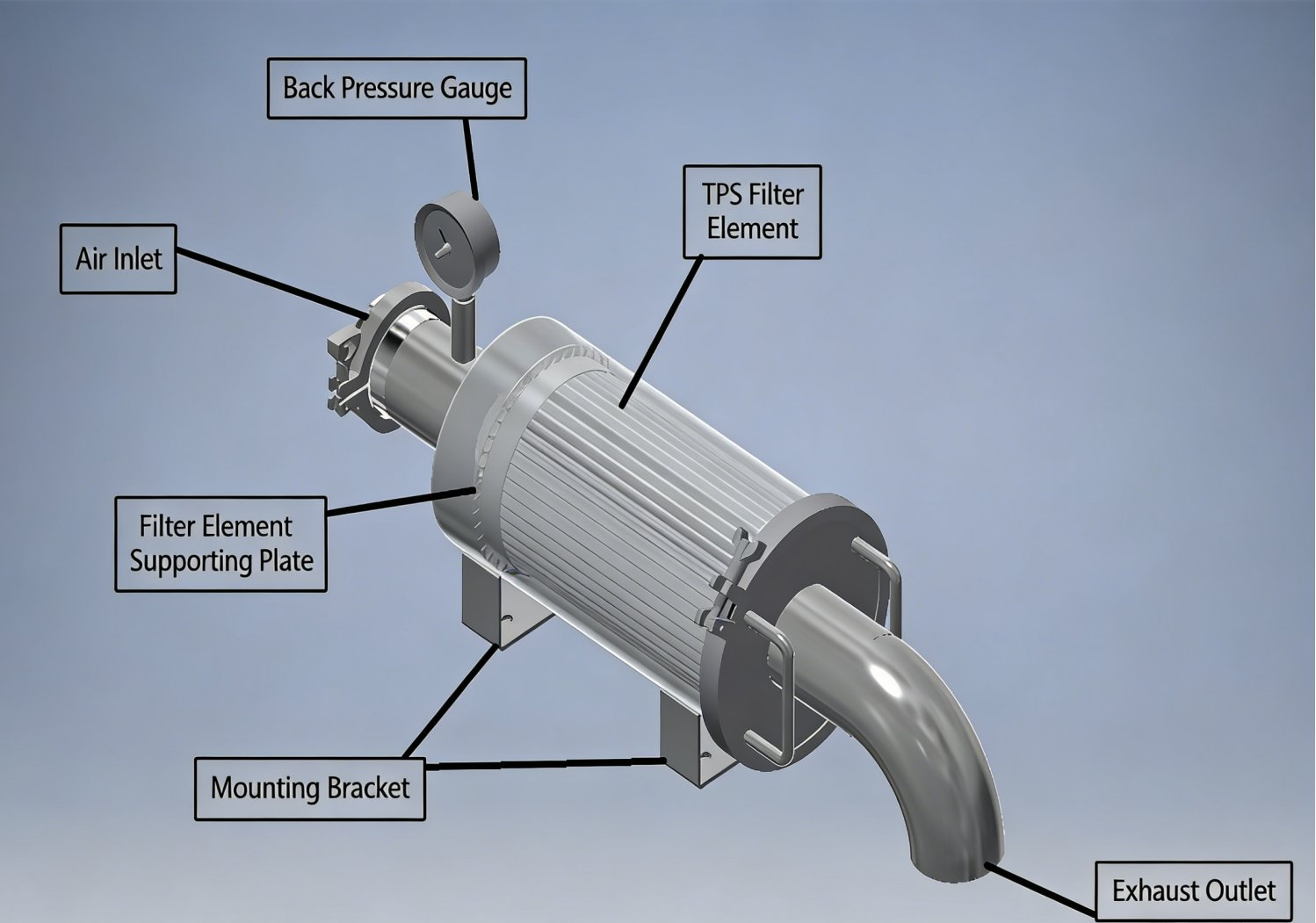
Unlike a ceramic wall-flow substrate, the metal wall is elastic and tolerant of vibration and thermal shock, so the unit mounts like a standard exhaust component — no electric heaters, no fuel-borne catalyst dosing.
25 kPa: the one number to watch
The more soot sits on the outer surface, the higher the back pressure — and back pressure is the only signal you need; no teardown inspection required. In our laboratory test at 50±1 Hz and 24±1 kW load, back pressure reached 25 kPa with roughly 30.5 g of soot accumulated on the element. That measurement is why we quote 25 kPa as the wash threshold.
The operating rule is short: wash the element when the gauge nears 25 kPa; if a differential-pressure alarm is fitted, set it at the same value. Running above 35 kPa for extended periods makes the engine noticeably underpowered and can damage the element itself.
500 °C: the hard temperature boundary
The element is heat-resistant, but the complete unit is designed for continuous service up to 500 °C. If an engine fault pushes exhaust temperature above 550 °C, the accumulated soot can reach its ignition point and burn — momentarily at up to 1600 °C, hot enough to melt both element and housing. This is not a material defect; it is the physical boundary of every particulate filter, because soot is combustible.
Three countermeasures for high-exhaust-temperature applications:
- Mount it far.Install the unit away from the engine outlet and make the inlet pipe as long as practical — and leave it uninsulated, so the pipe itself helps cool the gas.
- Fit a temperature alarm.Sound and stop the machine when exhaust temperature hits 450 °C.
- Respect the threshold.Wash at 25 kPa without delay — the thicker the soot layer, the higher the ignition risk.
Washing regeneration: seven steps, no kiln
- Shut down and cool.Shut down the engine, put on gloves and let the tailpipe and housing cool down to avoid burns.
- Release the clamp.Release the clamp that holds the purifier housing.
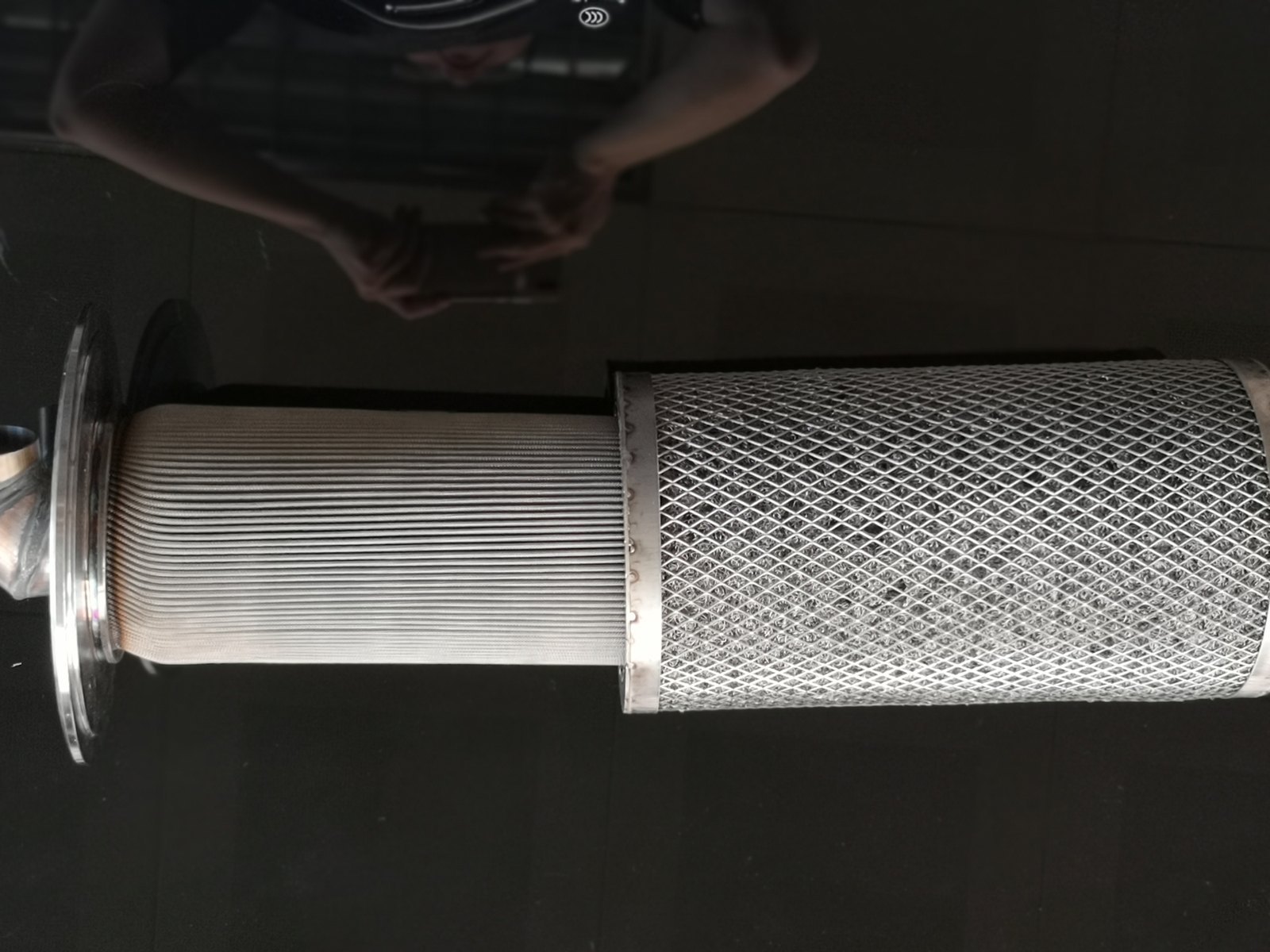
- Withdraw the element.Grip the element handle and withdraw the filter element slowly and steadily; place it near a water tap.
- Rinse.Rinse the element with tap water (a pressure washer also works), rotating it as you go, until the runoff runs clear — about one minute.
- Remove oily film.If oily deposits remain, add a little dish detergent to the water. Never scrape the element surface with hard metal tools.
- Refit.Slide the element back until it is fully seated and the gasketed end face sits flush against the housing face.
- Tighten and restart.Refit and tighten the clamp until fully sealed, then restart the engine and resume operation.
Two things that look like faults but are not
A freshly washed element has open pores and slightly lower initial capture efficiency, so a little white vapor in the first minutes is normal. If black smoke persists after cleaning, check three things in order: the gasket is aligned and compressed, the drain bolt at the element bottom is tight, and the engine was properly warmed up before load.
How this differs from a DOC + ceramic DPF route
New on-road trucks (Euro IV and above) overwhelmingly use DOC + ceramic DPF. That route works well with matched exhaust temperatures and fuel quality, but four concrete issues appear when it is retrofitted onto existing non-road engines. To be clear: this is about route boundaries, not ranking one technology over the other.
| Dimension | Washable metal DPF | DOC + ceramic DPF |
|---|---|---|
| Regeneration condition | Independent of exhaust temperature; a rinse restores flow | DOC needs roughly 350 °C for best regeneration; small non-road engines rarely run that warm |
| Fuel tolerance | Capture physics is unrelated to sulfur content | High-sulfur diesel poisons the DOC precious-metal catalyst quickly, and the ceramic DPF behind it plugs |
| After plugging | Stop, release the clamp, rinse for about a minute, refit | Cool 1–2 h, kiln-burn with 2–3 h slow ramp-up and ~2 h cool-down, then reverse-purge with compressed air |
| Substrate life | Metal element is rinsed and reused indefinitely in normal service | Ceramic substrates embrittle after repeated kilning — commonly scrapped after 5–6 cycles |
One practical difference more: the precious-metal loading of a DOC is hard to verify in the field, so retrofit disputes have no fast arbiter. A metal element’s condition can be judged by anyone from the gauge and a visual check — both parties read the same number.
Which configuration for which duty
| Application | Character | Recommended setup |
|---|---|---|
| Diesel generator sets | Long steady load, higher displacement and exhaust temperature, room for hardware | Multi-core metal purifier (6–24 cores), with back-pressure gauge; add a DOC stage and emergency bypass valve when CO removal is also required |
| Non-road machinery (forklifts, loaders, cranes, tractors) | Small engines, intermittent duty, mixed fuel quality from field stations | Single- or dual-core washable metal purifier, flange or clamp mounted |
| Heavy smoke (free-acceleration opacity above 2.0 m⁻¹) or long maintenance intervals | Poor combustion, fast soot load, downtime is expensive | Multi-stage filtration: pre-filter + mid filter + high-efficiency metal DPF |
| Tunnels, mines, enclosed sites | Soot plus odor and CO must both be addressed | Metal element + DOC combination with emergency bypass valve |
Frequently asked questions
At what back pressure should I wash the element?
25 kPa. It comes from our lab measurement (about 30.5 g of soot at 50±1 Hz and 24±1 kW) and field experience; set the differential-pressure alarm at the same value. Sustained operation above 35 kPa without cleaning makes the engine underpowered and can damage the element.
How long does one cleaning take?
The rinse itself takes about one minute. Including cool-down and clamp work, a practiced operator finishes within one routine stop — no kiln, no power supply, no dedicated workshop bay.
Does the metal element have a replacement interval?
No fixed interval. The element is rinsed and reused following the seven steps above; its condition is judged by normal back pressure and an undamaged surface. This differs from ceramic substrates, which are commonly scrapped after 5–6 kiln cycles.
Will high-sulfur diesel ruin the purifier?
Not the soot capture itself — a metal DPF works by physical interception, with no precious-metal catalyst. But if a DOC stage is fitted, high-sulfur fuel will poison it; that is a constraint of every catalytic route, and it is why we always ask about local fuel quality during sizing.
Can it be fitted to high-exhaust-temperature engines?
Yes, with the 500 °C limit designed in: lengthen the inlet pipe and leave it uninsulated, fit a 450 °C temperature alarm, and wash strictly at 25 kPa. With those three in place, high-temperature gensets run long-term without issues.
How do I confirm it suits my equipment?
Send us the engine model and displacement, the equipment type (genset, forklift, construction machinery), the local emission requirement and the space available — we confirm fitment and quote within one business day.
Send us your duty cycle — fitment confirmed within one business day
Share the engine model, equipment type and local emission requirement, and we will recommend a configuration based on the logic above. WhatsApp reaches us directly on working days.
Related pages: Metal Exhaust Gas Purifier · Dry Genset Black Smoke Purifier · Invention Patent & Test Report (CMA/CNAS accredited)
Data sources: AIFILTECH laboratory back-pressure records (50±1 Hz, 24±1 kW), TPS purifier operating manual, airport multi-stage filtration field cases. For interval and troubleshooting detail, see the metal DPF maintenance guide. For a route-by-route comparison, see metal DPF vs DOC + ceramic DPF fit boundaries. Products tested by CMA- and CNAS-accredited laboratories (report K20-WT50002).