
Metal DPF Maintenance: How Often to Wash, What to Check, What to Do When It Misbehaves
Metal DPF maintenance comes down to one gauge reading: wash at 25 kPa, ignore it below that. There are no consumables and no scheduled service items. What an operator actually needs to know is the meaning of three signals — exhaust color, back pressure and engine feel. This guide puts them in checklist order.
How often: watch the gauge, not the calendar
There is no fixed interval, because duty cycles differ too much. Heavy, sooty equipment loads the element in days; lightly used machines can run for weeks. So schedule by pressure, not by calendar: glance at the gauge at every start-up, and when it nears 25 kPa, wash the element after that shift. With a differential-pressure alarm, set it at 25 kPa and let it do the remembering.
What happens above 35 kPa if nobody washes: first the engine feels dull and burns more fuel; sustained, it can crush and damage the element. 25 kPa is not a suggestion — it protects both the engine and the element.
Thirty seconds at every start-up: two things to look at
- The back-pressure gauge.The needle drops near the empty-load value after a cold start; a slow climb during running is normal. A steep rise or a persistently high reading means it is wash time.
- Exhaust color.Virtually colorless at steady running; a little white vapor, especially when cold, is normal. Sustained black smoke goes to the table below.
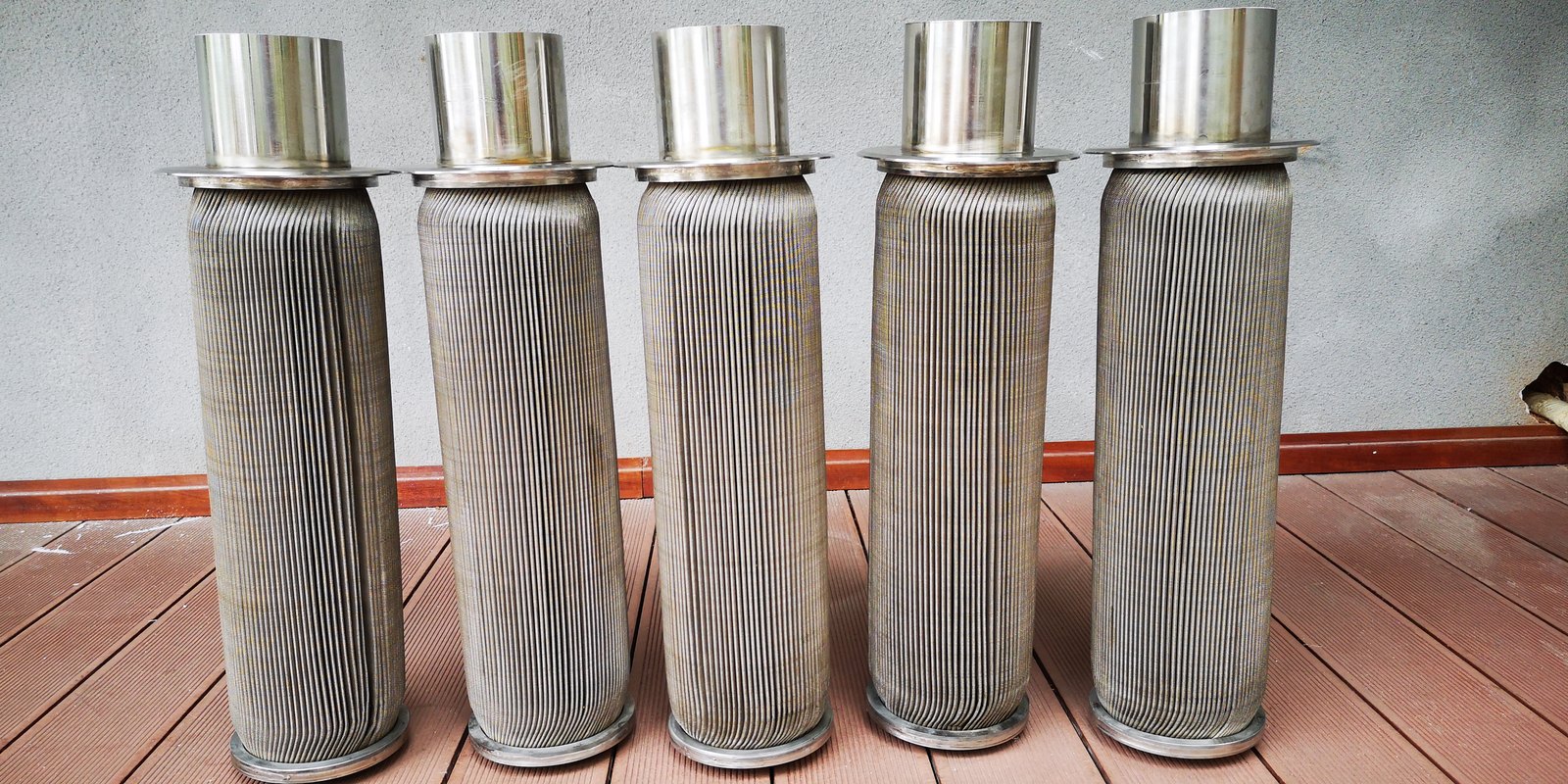
Black smoke, white vapor, sluggish engine: troubleshoot in this order
| Symptom | Likely cause (in order) | Action |
|---|---|---|
| White vapor, fades within minutes | A new or freshly washed element has fully open pores and slightly lower initial capture efficiency; oil mist leaves with the vapor | Normal. It disappears as the engine warms up — no action needed. |
| Black smoke, persists after washing | ① Gasket misaligned or not compressed, exhaust bypassing the element; ② drain bolt at the element bottom not tight; ③ load applied before warm-up | Stop and check ①→②→③: seat the gasket, tighten the drain bolt, warm up before loading. |
| Engine feels underpowered | Back pressure past 25 kPa unwashed; in the worst case, long operation above 35 kPa has damaged the element | Wash immediately. If pressure stays high after washing, inspect the element surface for damage and replace if needed. |
| Still black after washing, all three checks fine | Element may be damaged — scored by a hard tool or deformed by overtemperature | Pull the element and inspect the surface; replace a damaged element outright, never patch it. |
One rule that settles most cases
Nearly every “the purifier stopped working” report ends at one of two things: a badly seated gasket, or an overdue wash. Check those before anything else.
Three details while washing
- Any water source, any angle.A garden hose or a pressure washer both work; rotate the element as you rinse until the runoff runs clear — about one minute.
- Greasy, oily film: add dish detergent.Unburned oil can leave a tacky film on the surface; a little detergent in the water lifts it, then rinse the foam off.
- Keep tools off the surface.Never scrape the element with hard metal objects — a scratch today is a crack tomorrow. Wear gloves, mind hot surfaces, and keep black rinse water off clothing.
The temperature reminder (as important as washing)
The unit is rated for continuous service up to 500 °C. If exhaust temperature runs above 550 °C, accumulated soot can ignite — momentarily up to 1600 °C — and melt both element and housing. A heat-damaged element cannot be washed back to service; it is replaced. Countermeasures for hot-exhaust engines (long uninsulated inlet pipe, 450 °C alarm, strict 25 kPa washing) are on the working-principle page.
When does an element actually need replacing?
Metal elements have no fixed service life. Three situations call for a replacement: a surface scored by hard contact, deformation or melting after an overtemperature event, and back pressure that no longer returns to normal after repeated washing. Everything else is a wash-and-reuse cycle — there is no “replace by hours”, the fundamental maintenance difference from ceramic substrates that embrittle and are scrapped after repeated kilning.
Frequently asked questions
How long can I typically go between washes?
Anywhere from days to weeks depending on duty. Watch the gauge rather than the calendar: wash at 25 kPa. Multi-stage filtration stretches the interval several times on heavy duty — the airport case stayed under 15 kPa for 30 consecutive days.
Where should I set the differential-pressure alarm?
25 kPa, the same threshold as manual reading. When it sounds, plan a wash for the end of that shift — no need to stop immediately.
What tools and space does cleaning need?
Gloves and a tap or pressure washer. No kiln, no power supply, no compressed air, no workshop bay — the element washes under a faucet.
Any problem washing outdoors in winter?
No. The element is metal and indifferent to water temperature; shake off the water and refit. Residual moisture leaves as white vapor during warm-up.
Can a removed element be stored?
Yes. Rinse, drain and keep it dry — no anti-oxidation measures needed. Check gasket seating during the next refit.
Can you predict the wash interval for my machine?
We can estimate it. Send the engine model, equipment type and typical load; we quote a reference range from comparable installations, and the first week’s gauge readings calibrate it.
Send us your duty cycle — fitment confirmed within one business day
Share the engine model, equipment type and local emission requirement, and we will recommend a configuration, a quote and a reference wash interval for your duty. WhatsApp reaches us directly on working days.
Further reading: How a washable metal DPF works — airflow, the 25 kPa threshold and cleaning (includes the seven-step procedure)
Related products: Metal Exhaust Gas Purifier · Dry Genset Black Smoke Purifier · Invention Patent & Test Report
For interval and troubleshooting detail, see the metal DPF maintenance guide. Sources: TPS purifier operating manual, airport multi-stage filtration field records.
Teams holding many elements may prefer the automatic filter washing equipment for batch cleaning.