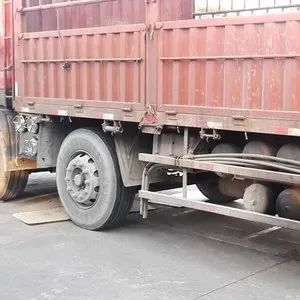
“Within the following port areas, Guo-IV diesel trucks are prohibited at all times.” Yueqing placed that line in the second clause of a notice dated November 3, covering the Qili terminal at Oujiang port and Yueqing Bay port from January 4, 2027, for ten years.
Taizhou moved first with the same package – a wider ban zone for non-road machinery plus port access limits for Guo-IV trucks. Published on July 23, it took effect on October 15, twenty-seven days ago. Yueqing has fifty-four days left.
A Blanket Ban on Guo-III, a Pinpoint One on Guo-IV
Both notices share a frame. Non-road machines are judged by smoke: anything failing the Class III limit in GB 36886-2018 counts as high-emitting and is barred from the zone around the clock. Trucks are judged by registered emission stage and blocked only inside mapped port perimeters. Enforcement splits the same way – the ecology bureau handles machinery, the traffic police handle trucks.
Coverage and identification differ. Taizhou pushed its machinery ban across most of Jiaojiang, Huangyan, Luqiao and the Taizhou Bay new area, while restricting trucks only in two blocks around Haimen port. Yueqing drew one ring around the city centre and two around its ports. Taizhou also defines Guo-IV trucks as those built between July 1, 2013 and January 1, 2018; Yueqing relies on the certificate alone, with no model-year window.
Ports are singled out because of duty cycle. Drayage is short-haul: low speed, long idling, queueing for a berth, exhaust temperature that never climbs. A Guo-IV truck’s DOC and DPF are at their worst in that rhythm – soot loads faster than passive regeneration burns it off, and the opacity test finds it first. Most of these trucks run their annual kilometres within three kilometres of the gate.
One boundary needs stating. Fitting or replacing aftertreatment changes opacity, not the emission stage printed on the registration. A retrofitted Guo-IV truck still cannot enter the zone; only a replacement or an electric unit can. The retrofit market sits outside the perimeter, among drayage and yard fleets not yet drawn into a ring. That is the fleet the truck exhaust purifiers and non-road exhaust purifiers are built for.
Access lines usually start at the port and move inland later. Taizhou took six years to go from its 2020 zone to this expansion. Yueqing closed two ports at once.
Both notices replace earlier rules rather than invent new ones – Yueqing repeals its 2020 designation, Taizhou its 2020 notice. What changes is the perimeter, not the principle. Operators reading the two documents side by side should watch the definition clause first: a certificate-based rule catches every truck registered as Guo-IV, while a model-year rule can leave late-registered units outside the ban.