
Inside an Electrolyzer Stack: Layers, Materials and Failure Points
An electrolyzer stack looks intimidating in a marketing render, but mechanically it is a sandwich pressed between two end plates. Once you can name every layer and say what it must survive, material selection stops being guesswork. This guide walks one repeat unit from the outside in, then looks at the four interface details that decide whether the stack performs for years or loses voltage within months.
The repeat unit, layer by layer
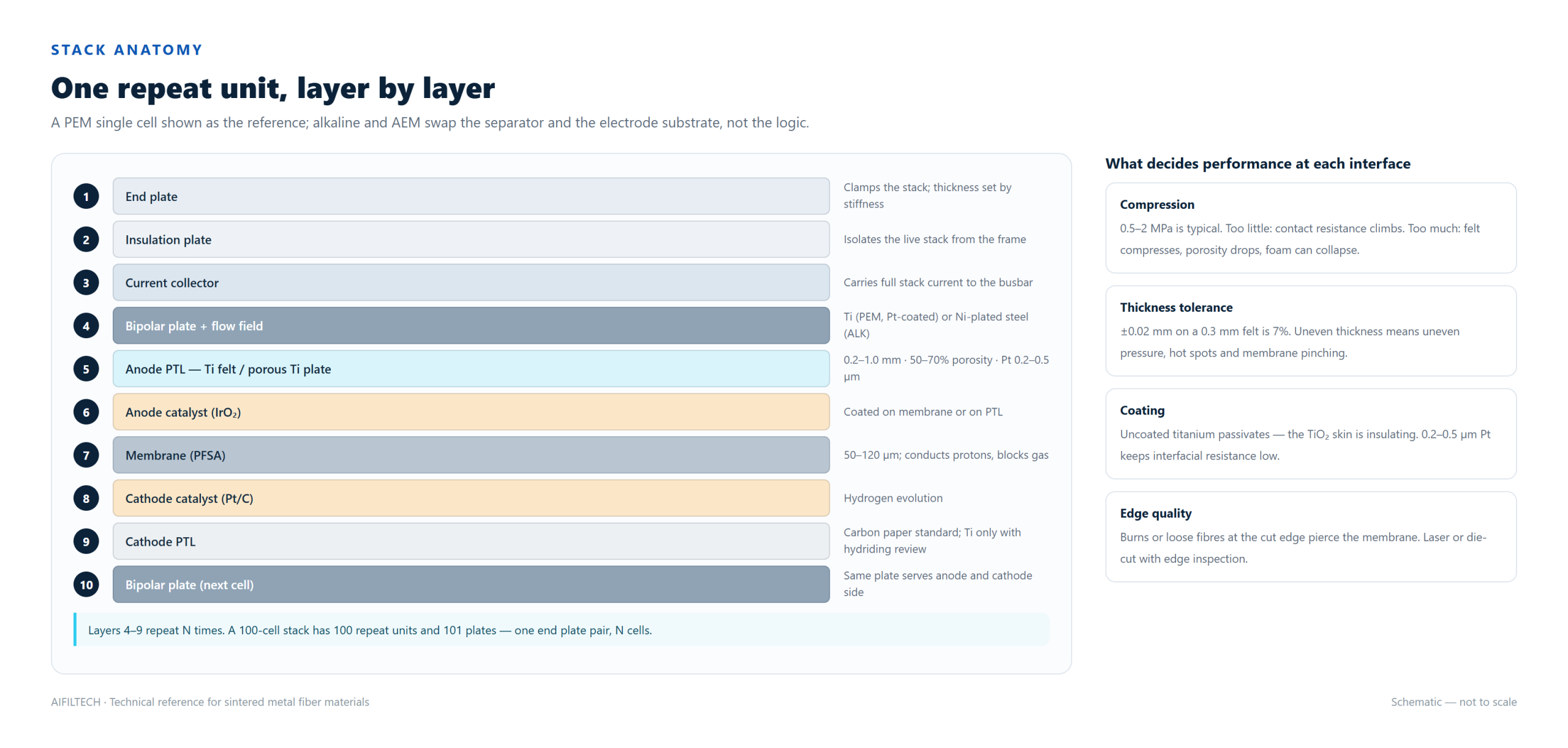
| # | Layer | What it does | Common material choices |
|---|---|---|---|
| 1 | End plate | Clamps the stack, reacts tie-rod force | Thick steel or titanium; stiffness decides thickness |
| 2 | Insulation plate | Isolates the live stack from the frame | Engineering plastics, epoxy laminates |
| 3 | Current collector | Carries full stack current to the busbar | Copper with plating, plated steel |
| 4 | Bipolar plate + flow field | Separates cells, distributes water and gas | PEM: Ti with Pt coating; ALK: Ni-plated steel or Ni |
| 5 | Anode PTL | Feeds water, drains O&sub2;, conducts current | Ti felt / porous Ti plate (PEM); Ni mesh or foam (ALK) |
| 6 | Anode catalyst | Oxygen evolution | IrO&sub2; (PEM); Raney Ni / NiFe (ALK, AEM) |
| 7 | Membrane / diaphragm | Conducts ions, keeps gases apart | PFSA membrane (PEM); ZrO&sub2;/PPS diaphragm (ALK); AEM membrane |
| 8 | Cathode catalyst | Hydrogen evolution | Pt/C (PEM); NiMo / Raney Ni (ALK, AEM) |
| 9 | Cathode PTL | Feeds water, drains H&sub2;, conducts current | Carbon paper (PEM); Ni felt / Ni mesh (ALK, AEM) |
Layers 4–9 repeat N times. A 100-cell stack is not 100 exotic components — it is one well-specified repeat unit, manufactured a hundred times with tight consistency, plus one end-plate assembly.
Where alkaline and AEM differ
The sandwich logic is identical; three things change:
- The separator. ALK uses a porous diaphragm that only blocks gas bubbles — ions travel through the liquid electrolyte. PEM and AEM use solid membranes, which is why cell spacing (the “zero-gap” concept, pressing the electrodes against the separator) matters so much in modern alkaline design.
- The electrode body. ALK electrodes are nickel: mesh, foam or felt carrying Raney-type or NiFe catalytic coatings. There is no precious-metal layer to protect, so the substrate choice is driven by conductivity, porosity and cost.
- The hardware chemistry. Caustic solution makes nickel the default for plates and frames; titanium appears only where a design wants extra corrosion margin (some AEM anodes) or where the plant environment, not the cell, demands it.
The four interface details that decide performance
- Compression. Published stack designs commonly operate around 0.5–2 MPa of through-stack pressure. Too little leaves contact resistance between plate, PTL and catalyst; too much squeezes porosity out of a felt and can permanently crush nickel foam. Compression must be specified together with thickness and its tolerance.
- Thickness tolerance. On a 0.3 mm felt, ±0.02 mm is already 7%. Uneven thickness means uneven local pressure: hot spots in some regions, membrane pinching in others. This is why areal thickness uniformity matters more than the nominal number.
- Coating. Uncoated titanium passivates — the TiO&sub2; skin that protects it chemically is an electrical insulator, and it thickens under anodic potential. A 0.2–0.5 μm Pt coating keeps the interface conductive. Nickel needs no coating in KOH but must never be used where the environment turns acidic.
- Edge quality. The cut edge of a fiber felt carries loose fibers and burrs; pressed against a 50–120 μm membrane, a single fiber can initiate a pinhole. Laser or die cutting with edge inspection is part of the material spec, not a nice-to-have.
Failure points engineers report first
- Rising cell voltage after weeks of operation, traced to an uncoated or under-coated titanium interface.
- Membrane pinhole at the PTL edge, traced to burrs or fibre shedding.
- Gas purity drift at low load in alkaline stacks — a crossover issue, not a materials one, but it constrains how the PTL and diaphragm interact.
- Localized over-compression where a warped bipolar plate presses hardest, crushing foam or over-densifying felt in one region.
For a deeper comparison of the two workhorse substrates, see nickel felt vs titanium felt, and for the 2D alternatives see nickel mesh, titanium mesh, nickel foam and porous titanium plate.
Frequently asked
What are the main components of an electrolyzer stack?
End plates, insulation plates, current collectors and tie rods on the outside; inside, a repeat unit of bipolar plate, anode PTL, anode catalyst, membrane or diaphragm, cathode catalyst and cathode PTL. The repeat unit is manufactured N times under uniform compression.
What does the porous transport layer actually do?
Three jobs at once: bring water to the catalyst, drain gas bubbles away, and carry current between the bipolar plate and the catalyst layer. Its porosity, thickness and surface conductivity therefore affect efficiency and lifetime simultaneously.
Why is titanium felt platinum-coated?
Titanium’s protective oxide skin is electrically insulating and grows under anodic conditions. A thin Pt coating (0.2–0.5 μm in common commercial specs) keeps the PTL-to-catalyst contact resistance low and stable.
How much compression does a stack need?
Designs commonly target 0.5–2 MPa. The right number depends on the PTL: felt tolerates compression well, foam does not, rigid porous plates need uniform flatness instead. Compression, thickness tolerance and flatness should be specified as one package.
Need a material quote for your stack?
AIFILTECH sinter-manufactures the porous metal layers that go between the bipolar plate and the catalyst: titanium fiber felt (with optional Pt coating 0.2–0.5 μm), porous titanium plates, nickel fiber felt, mesh-reinforced nickel felt, nickel mesh and multi-layer sintered mesh.
- Send us: stack type (PEM / alkaline / AEM), active area per cell, target thickness, porosity, coating requirement and annual volume.
- You get: a specification confirmation within one business day, sample sheets for stack trials, and consistent batch data.