“Where a clinker project’s actual capacity exceeds its registered capacity, the excess must be offset through capacity replacement.” One clause, six departments. On November 9, Shandong’s provincial departments for industry, science and technology, finance, ecology and environment, housing and construction, and emergency management jointly published the Building Materials Industry Development Action Plan (2026-2030), and that clause is the hardest line in it: no new clinker or flat glass capacity in air-pollution priority zones, and no free expansion anywhere else.
The plan stacks three constraints on the kiln fleet. Capacity replacement policy stays strict. Production lines in cement and flat glass must be verified and reported on a list, and any capacity above the registered figure has to be paid for with replacement indicators. Peak-season staggered production remains in place, with the province encouraging a self-disciplined, year-round version on top of it.
The green clauses go beyond the stack. The plan calls for “six-zero” benchmark factories and near-zero-carbon lines with simultaneous ultra-low emission upgrades of kilns, energy-saving retrofits for cement and glass plants, refuse-derived and biomass fuel substitution, and wider co-processing of industrial waste, household waste and sludge in cement kilns. By 2030 the province targets more than 60 national-level green factories and 65 provincial ones.
Extra capacity has to be paid for in indicators
What the plan really tightens is the link between capacity and emissions. With no new capacity, existing kilns can only compete on two things: energy indicators and emission performance. Northern provinces have scheduled 151-255 days of kiln stoppage in their 2026-2027 staggered-production plans, and a kiln that keeps stopping and restarting must hold ultra-low emission levels through every cold, humid restart. Staggered production is seasonal; ultra-low emissions run all year, and the year-round test decides who survives under the new rules.
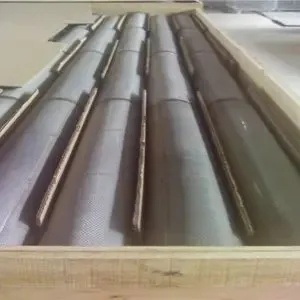
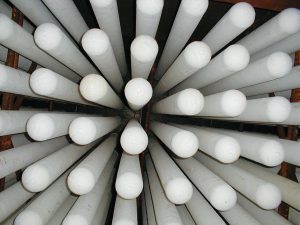
Shandong sits in the first tier of national cement and flat glass capacity, so the freeze carries weight beyond provincial borders. On the hot flue gas side, the filter media decide whether ultra-low emissions hold across those cycles: washable, hydrolysis-resistant metal filter bags for the low-temperature windows, and ceramic fiber filter tubes rated to 1,600 degrees C for glass kilns and coking trains – the two categories AIFILTECH covers with its metal filter bags and ceramic fiber filter tubes. With capacity frozen, the competition moves from tonnage to indicators.