Can a national plan retire a country’s working diesel fleet in five years? China’s new transport blueprint says “basically” — and that word carries weight. The Green Transport Development Plan for the 15th Five-Year Period, issued by the Ministry of Transport together with the railway, civil aviation and postal regulators, was released in full on 24 November. Its headline commitment: old high-emission trucks, ships and diesel locomotives phased out by 2030, with NOx emissions from commercial transport equipment falling significantly.
15.3% to 25%, and 4% to 20%
Two pairs of numbers show the scale of the ask. New-energy vehicles are to make up 25% of the commercial fleet by 2030, up from 15.3% in 2025. For heavy trucks the jump is steeper: from about 4% to 20%. The plan also names where replacement starts — not the open highway, but enclosed yards. Ports, freight hubs, coal storage bases and steel, power, coking and cement plants must speed up new-energy substitution for yard-transfer and short-distance vehicles, with capable enterprises moving to “full replacement where feasible” in key regions such as Beijing-Tianjin-Hebei and the Fenwei Plain.
Watching from above
Enforcement language matters as much as the targets. The plan commits to drone sniffing, online monitoring and optical remote sensing for ship emissions, plus full-process supervision of shore power use. Roadside spot checks are giving way to wide-area scanning of anchorages and freight corridors. For operators, staying legal stops being a once-a-year inspection exercise and becomes a continuous condition across the whole operation.
Diesel stays in the plan
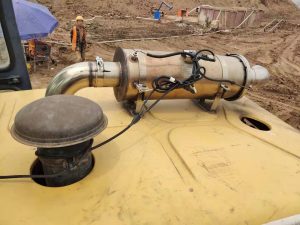
Notably, the same document calls for continued innovation in high-speed diesel engines for locomotives. The exit order targets “old and high-emission” equipment, not diesel fuel itself. Fleets that must keep diesel running through the transition window will be judged on live emissions, and retrofit aftertreatment is one way to hold the line — a truck exhaust gas purifier for haulage vehicles, or equipment matched to a non-road vehicle black smoke purifier for port and in-plant machines. The five-year table is posted; the retrofit schedule is each fleet’s own to write.