“Diesel generator (DG) sets used across industrial, commercial, residential and office establishments are one of the contributing sources of particulate matter and gaseous pollutants.” The line opens a Commission for Air Quality Management order dated 18 November 2026. What follows is the part worth reading twice: the commission has asked a panel to judge whether the devices it made compulsory actually work in service.
The group has eight members, drawn from Delhi Technological University, IIT Delhi, IIT Bombay, the International Centre for Automotive Technology, the Automotive Research Association of India and the Central Pollution Control Board. It may co-opt others. Its report is due in two months, which lands around mid-January 2027, before the next winter season starts loading the same sets.
Three questions, one order
The mandate is narrow. First, whether the existing emission standards for DG sets are adequate, band by band. Second, how retrofit emission control devices (RECD) and dual fuel kits (DFK) perform in operation, not only on the bench. Third, where the implementation gaps sit, technical and operational and compliance, across the National Capital Region.
Those questions map onto a rule the commission has been tightening since 2023. Direction No. 76, issued on 29 September 2023, regulates DG operation across industrial, commercial, residential and office establishments in NCR. It sorts sets by capacity and attaches a route to each band: dual-fuel operation, a certified RECD, or a choice between the two, with gas-fuelled units and new CPCB IV+ sets up to 800 kW outside the retrofit requirement. The direction was amended on 22 February 2024 and again on 11 December 2024, both times because certified RECDs had become available in lower capacity ranges.
That last detail explains the review. Each time certification reached a smaller engine, the compliant route widened and the boundary between bands moved. After two amendments, the thresholds describe a market that has changed underneath them.
Certified is not the same as working
A certificate is issued on a type test. A genset in a basement runs on a different dataset: hours at light load, cold starts, soot that never burns off, ash that has nowhere to go. A device sized for continuous duty can pass certification and still load up fast on a standby set that only runs during outages. Backpressure climbs, the set derates or trips, and the cheapest response on site is to pull the element or crack open a bypass. Certification is a type test. Field life is not.
That is why the second question in the order carries more weight than the first. If the panel recommends testing at real load points, or asking owners to log backpressure between services, the retrofit market shifts from fit once to prove it still works. For manufacturers and importers, that changes what has to be documented at handover. For plant engineers, it turns the maintenance interval from a guess into a number.
Twenty inspections out of eighty-two
Enforcement figures released the same week show how thin the inspection layer is. CAQM flying squads carried out 82 inspections between 27 October and 9 November 2026: 19 at construction and demolition sites, 43 at industrial units and 20 at DG sets. Cumulatively to 16 November, 29,041 units and projects had been inspected, producing 1,849 closure directions, 105 resumption orders and 130 referrals to state pollution control boards.
Twenty DG inspections in a region where sets are rented, bought second-hand and often unregistered is not a sampling rate anyone would call statistical. It is a signal. The order’s third question, on implementation gaps, concedes that a certified device on paper and a compliant device on site are two different populations.
Delhi’s air improved enough for Stage III of the Graded Response Action Plan to be revoked on 18 November, with the daily average AQI at 204. Stages I and II stayed in force, and the DG provisions under Direction 76 apply year-round regardless of GRAP stage, so the review is not a winter-only file.
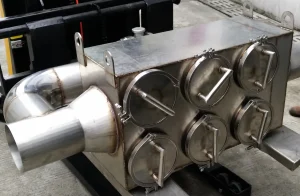
For a facility already on the retrofit route, the question the panel is circling is duty matching. A device specified for prime power and one specified for standby power see very different soot loads, and the difference shows up as backpressure long before it shows up as a visible plume. AIFILTECH builds the dry generator set black smoke purifier around that distinction, and the genset emissions application page sets out how capacity bands and duty cycles move the specification.