0.015 grams per kilowatt-hour – that is India’s new particulate-mass limit for diesel engines in construction equipment, tighter than many road-vehicle limits. The notification gazetted on July 1, G.S.R. 542(E) (the Central Motor Vehicles Eleventh Amendment Rules, signed June 30, 2026), repackages these requirements into Rule 115A, and one of them quietly took effect in October.
Two dates of October 1 sit in this amendment. For tractors, TREM Stage V takes effect for most power bands on October 1, 2026, with the 19-37 kW band deferred to April 2028. For construction equipment vehicles (CEV), Stage V applicability remains January 1, 2025; what actually switched on October 1 is different – construction equipment manufactured after October 1, 2026 with engine power above 56 kW must undergo in-service emission monitoring, with the 19-56 kW band following from April 1, 2028.
What Stage V asks a machine to carry
Engines from 19 to 560 kW face a particle-number limit of 1×10^12 per kWh and a particulate-mass limit of 0.015 g/kWh; in the 56-130 kW band, CO sits at 5.0, HC at 0.19 and NOx at 0.4 g/kWh – a combination that in practice only a diesel particulate filter plus SCR can meet. Stage V ammonia is capped at a 10 ppm mean, urea must conform to ISO 22241 or IS 17042, and emission durability periods run in steps of 3,000, 5,000 and 8,000 hours, or assigned deterioration factors. ICRA estimates the machine-price impact at 12-15 percent for a direct Stage III-to-V jump, or 4-6 percent from Stage IV.
The 8,000-hour ledger
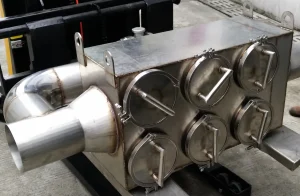
The weight of in-service monitoring sits inside those durability numbers: 8,000 hours is roughly five to six years of normal operation for a heavy-band machine, and a monitoring obligation means compliance is no longer a one-time type-approval test but a whole-life obligation. Whether a filter regenerates consistently and whether the urea system is maintained on schedule become the operator’s responsibilities, and second-hand valuations shift accordingly. The label requirement is part of the same push: TREM Stage-IV and Stage-V engines must carry an AIS:137 conformance label. AIFILTECH builds exhaust purifiers for non-road machinery and genset black-smoke purifiers precisely for the existing fleet – new machines are watched from the factory, which makes aftertreatment for the stock fleet only tighter. One industry ask is on record: in July, ICEMA requested an exemption for machines supplied to the armed forces and the Border Roads Organisation, arguing that thin air at about 4,200 meters degrades aftertreatment calibrated for plains conditions.