
MULCERAFIL Ceramic Fiber Filter Tubes
MULCERAFIL is the registered brand AIFILTECH uses for its ceramic fiber filter elements — Class 11, registration 76039447, and Class 7, registration 76052459. Two products sit under it: the standard ceramic fiber filter tube and the all-in-one catalytic tube. Both are rated up to 1600 °C, filter hot gas without a cooling step, and capture dust finer than 1 micron.
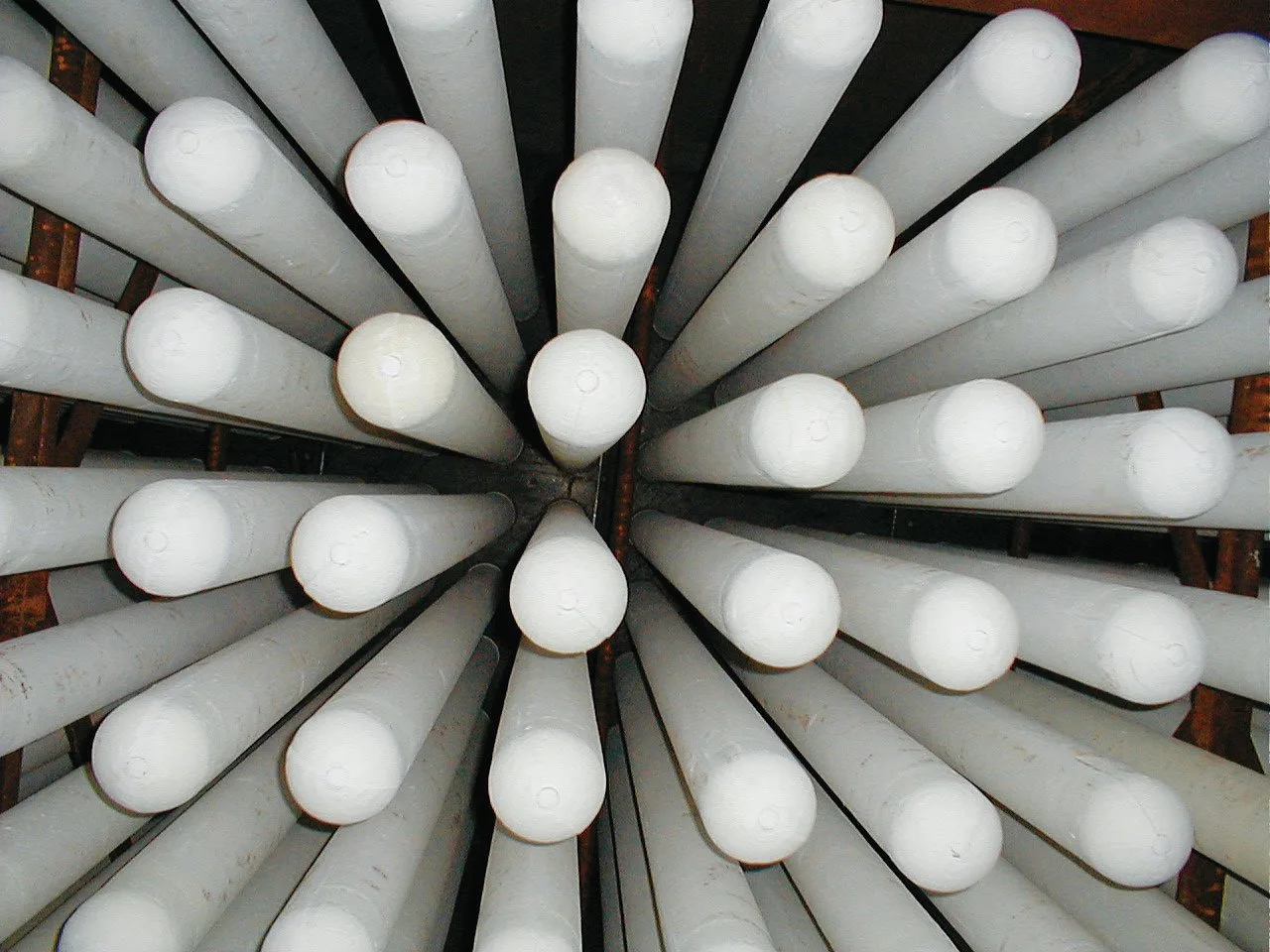
One brand, two tubes
Both tubes start from the same material — a low-density, porous body formed from bonded inorganic fiber granules. What separates them is whether a catalyst is built into the filter wall. Which one you need depends on what else is in the gas besides dust.
Standard ceramic fiber filter tube
- Media
- Bonded inorganic fiber granules
- Temperature
- up to 1600 °C
- Rating
- Below 1 μm
- Face velocity
- 3 m/min
- Emissions
- Below 2 mg/m³ under typical conditions
- Structure
- Rigid tube, no supporting cage
For duties that only need the dust taken out: the hot-side dedusting stage in waste incineration, metallurgy, glass, cement and chemicals.
All-in-one catalytic filter tube
- Catalyst
- Nano-catalyst distributed through the filter wall
- Co-removal
- Dioxins, NOx, VOC, acid gases
- Configuration
- Dust and gas-phase pollutants handled in one tube
- Temperature
- up to 1600 °C
For waste incineration and hazardous waste, where dust, dioxins and NOx all have to be controlled — it removes the need for a separate reactor downstream.
Why the tubes carry a brand of their own
A filter tube is not a commodity part. In the same baghouse, 50 mm of extra length or 5 mm on the flange diameter is enough to stop it fitting; change the wall thickness or the porosity and the pressure drop and cleaning cycle move with it. Buying by the category name “ceramic filter tube” is how plants end up with elements that fit but do not match.
Tying model, size and batch to one name gives you something to check against at replacement time. Quote MULCERAFIL and the size, and the original formulation and inspection record come back with it — instead of guessing from a photograph of the old tube.
The name covers ceramic fiber filter elements only. Metal filter bags, diesel DPF units and complete dust collectors are not sold under it; they belong to other AIFILTECH product lines.
Standard sizes
- Overall length
- 1000 / 1250 / 1500 / 1800 / 2000 / 2250 / 3000 mm
- Outer diameter
- 60 / 123 / 125 / 130 / 150 mm
- Flange height
- 15 / 20 / 30 mm
- Flange diameter
- 80 / 159 / 160 / 195 mm
- Area per tube
- 0.19 – 1.40 m²
Sizes above are standard. Non-standard lengths, flanges and hole patterns are made to order; a drawing or measured dimensions of the existing tube are needed before quoting.
Where it fits, and where it does not
Fits
- Inlet temperature stays above 500 °C and the system has no cooling stage
- Emission limits sit in the single-digit mg/m³ range
- Dioxins and NOx have to be handled on the same element as the dust
Metal filter bags fit better here
- Temperature below 600 °C with frequent thermal cycling
- Flue gas containing HF, where fluoride resistance governs
- Frequent start-stop with heavy mechanical shock on the elements
Alkali and heavy metals attack the glass phase of the media, so gas composition comes before temperature. Over-temperature shows up first as loss of strength and shrinkage; a rising pressure drop usually comes later.
See where metal filter bags fit →
Trademark and verification
- Mark
- MULCERAFIL (word mark)
- Registrant
- Guangzhou Tuokai Environmental Technology Co., Ltd.
- Class 11
- Registration 76039447
- Class 7
- Registration 76052459
- Registration date
- 21 June 2024
- Valid until
- 20 June 2034
- Goods covered
- Class 11 includes gas purifying apparatus, air purifying apparatus and machines, gas purifiers; Class 7 includes filtering machines, gas separating equipment, filters for purifying cooling air for engines
Registration numbers can be checked directly on the CNIPA trademark database. Certificates and full goods lists →
Four things to confirm before ordering
Gas flow (m³/h, stating whether normal or actual), inlet temperature and its swing, dust loading and acid components (HF, HCl, SO₂), and the local emission limit together with how it is measured. Once those four are fixed, tube length, filter area and cleaning method follow.
Need it sized for your process?
Send the four parameters and a site photo. We size against the standard range and quote; non-standard dimensions need a drawing.