Under the same round of staggered production, a kiln in northern China idles for up to 255 days; the shortest southern stop is 30 days. The gap can reach eightfold. Per Securities Times on November 6, Shandong, Xinjiang and Inner Mongolia are among the regions that have issued their 2026-2027 cement staggered-production notices: northern kilns idle 151 to 255 days, southern ones 30 to 65 – what Bainian Building Materials chief cement analyst Jiang Yuanlin sums up as a three-to-five-fold difference.
The 110% red line
This season’s biggest change is not the number of idle days but the way output is policed. Actual capacity must match registered capacity, with daily output capped at 110% of the registered figure; supervision has shifted from after-the-fact talks to monthly production checks, electricity monitoring and tiered regulation. Wang Qi of Zhuochuang Information calls it a combination punch of idling plus output control, credit penalties and swap restrictions. The backdrop is grim: national cement output fell 8.6% year on year to 1.13 billion tonnes in the first three quarters, the lowest for the period in eighteen years, with the average price down 44 yuan to 328 yuan a tonne. Conch’s nine-month net profit fell nearly 60% to 2.743 billion yuan, while BBMG Jidong lost 1.456 billion.
Longer idles age the filter bags faster
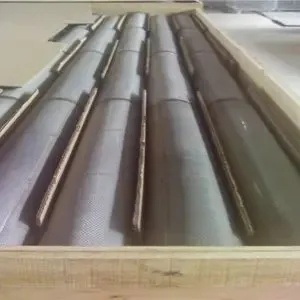
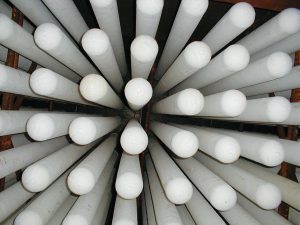
For kiln-tail dust collection, a shutdown is not a holiday. During a northern cold-standby lasting half a year, condensation and acid-dew-point corrosion work slowly inside the baghouse, and the acid that settles on bag cages is waiting when the kiln reheats; a southern kiln running continuously puts far milder duty on its filter media. And beyond idling, ultra-low-emission retrofit capital costs keep climbing – one of the four pressures ZYP Researcher Hong Qianjin lists for the industry. Retrofits are a one-off cost; running costs are annual, and the steel association’s ledger from late October (461 yuan of retrofit investment per tonne of capacity, 196 yuan a year to run) applies to cement just as well. The metal filter bags AIFILTECH builds for high-temperature kiln gas can be cleaned and regenerated after a shutdown and put back on line, and the ceramic fiber filter tubes are rated to 1,600 degrees C – both made for the cold-standby-to-reheat stretch that ages filter media fastest. With cement entering the national carbon market and quotas tightening in 2027, every bag you do not replace and every idle day you do not add is money kept.