
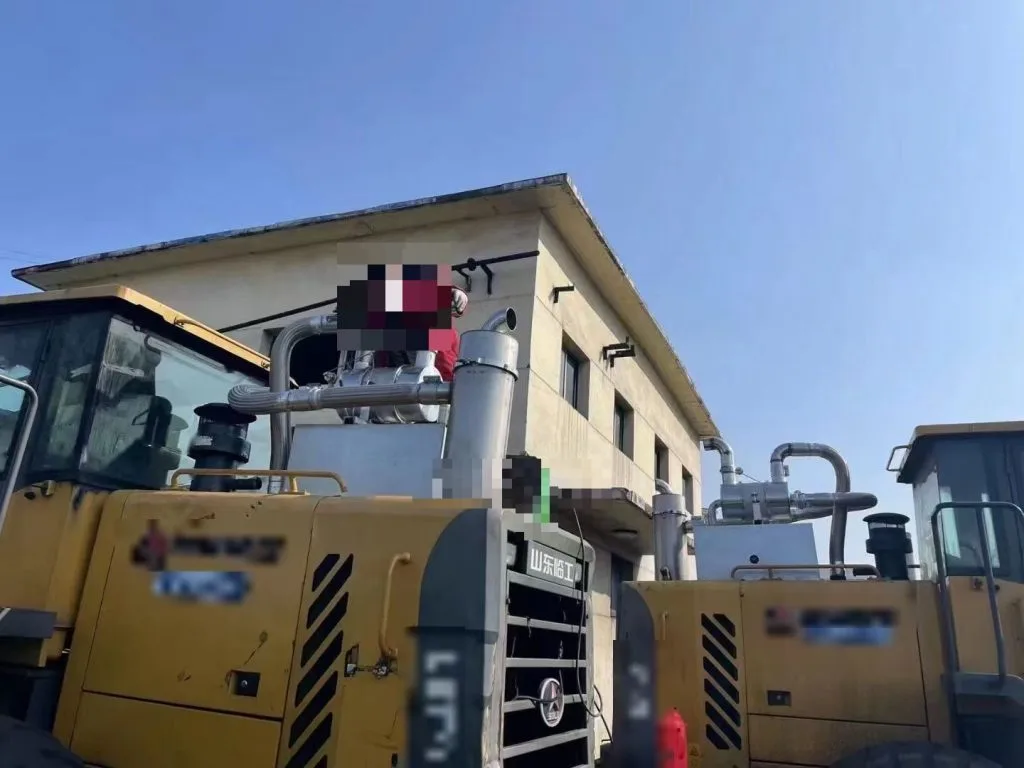
Diesel Exhaust Purifier FAQ: 36 Questions on Sizing and Metal DPF
Which purifier for black smoke only? At what backpressure should it be cleaned? Can the element last indefinitely? These 36 questions are the ones users of diesel vehicles, construction machinery and generator sets ask most often when selecting, matching and maintaining an exhaust purifier. The first 16 cover quick selection and system matching; the remaining 20 cover how a metal DPF and black smoke purifier captures soot, and the backpressure, temperature, cleaning and life questions that come with it. Answers are based on AIFILTECH metal DPF product documentation and field experience.
Jump to a question: every entry below links to its answer.
1. Quick selection and system matching
- 1. My machine only emits black smoke. Which purifier should I choose?
- 2. I need to control black smoke, NOx, CO and HC at the same time. Which combination should I use?
- 3. What is the difference between washable, dry, actively regenerated and DOC+DPF+SCR+ASC systems?
- 4. My machine runs for long periods at idle or light load. Which route fits better?
- 5. How does sizing differ between standby and continuously running generator sets?
- 6. What engine and site data do you need before sizing?
- 7. I only have the engine power, no displacement, exhaust flow or temperature. Can we size it anyway?
- 8. There are no site drawings. Can sizing be done from photos, video and manual measurements?
- 9. The engine is an old model and the full documentation is gone. Can it still be matched?
- 10. Emission standard, engine displacement or installation space: which one decides the model?
- 11. How do you calculate the number of elements, the filtration area and the unit’s backpressure?
- 12. Space on site is very tight. Can the outline, connection direction and maintenance direction be customised?
- 13. Do you supply a single purifier or a complete package with piping, valves, controls and installation?
- 14. Before quoting, can you provide a sizing calculation and a preliminary installation drawing?
- 15. If the engine power or the emission standard changes later, can the existing unit be upgraded?
- 16. If the chosen model turns out to be wrong, can the elements or configuration be changed instead of replacing the whole unit?
1. My machine only emits black smoke. Which purifier should I choose?
Where black smoke is the only symptom, the first route to assess is usually a DPF-led particulate trap rather than jumping straight to SCR. Whether that means a washable type, a low-maintenance dry type or an actively regenerated one depends on the engine’s raw emissions, load and exhaust temperature, daily running hours, allowable backpressure and the washing facilities on site. Black smoke can also come from a fuelling, air-intake or combustion fault, so rule out an engine problem first. One caution: actively regenerated DPF systems are still an immature route in China. They are expensive and very demanding on duty conditions, so think twice before choosing one.
2. I need to control black smoke, NOx, CO and HC at the same time. Which combination should I use?
The pollutants are usually split between stages: a DOC oxidises CO and HC, a DPF traps particulate matter, SCR reduces NOx with a reductant, and an ASC controls excess ammonia slip. The stages are not simply stacked. Raw emissions, exhaust temperature distribution, installation space, the backpressure budget and fuel sulfur decide the sequence and the size of each stage, and each pollutant gets its own acceptance figure.
3. What is the difference between washable, dry, actively regenerated and DOC+DPF+SCR+ASC systems?
A washable system relies on removable filter elements and manual maintenance, which suits machines that can be stopped for cleaning. A low-maintenance dry type cuts down on routine washing but still needs ash and backpressure management. An actively regenerated system burns off soot through thermal management, which suits low exhaust temperatures where the energy and controls are available. A four-stage system covers several pollutants at once and carries more complex controls, urea dosing and acceptance requirements; the DOC+DPF+SCR+ASC exhaust gas purifier page shows a typical configuration.
4. My machine runs for long periods at idle or light load. Which route fits better?
Long light-load duty is usually unfavourable to passive regeneration that depends on exhaust temperature, so give priority to a removable-wash design, a larger ash capacity or an actively regenerated system with proper safeguards. Do not size on maximum power alone. Check exhaust flow, temperature, backpressure and soot build-up at idle and at the usual load. If poor combustion is producing abnormal smoke, repair the engine first.
5. How does sizing differ between standby and continuously running generator sets?
A standby set is more about cold-start smoke, short test runs, long idle periods and the reliability of emergency power; maintenance follows the test-run log and backpressure. A continuous set is more about full-load flow, hot-state backpressure, ash capacity, cleaning downtime and energy cost. Whether a standby set has a bypass is not only a matter of convenience; it also depends on local emission requirements, alarms and operating records. Note that a permanently installed standby or emergency genset falls under a different standards system from non-road mobile machinery. The type-approval limits for new non-road engines (GB 20891) and the in-service smoke checks for non-road machines (GB 36886—2018) cannot be applied directly to a fixed standby set. Its regulatory status, applicable standard, limits and acceptance method should be confirmed case by case with the local ecological and environment authority.
6. What engine and site data do you need before sizing?
At minimum: engine make and model, displacement, rated and typical power, speed, exhaust flow or displacement data, typical exhaust temperature, the engine’s backpressure limit, and fuel and oil details. Also tell us the application, operating pattern, the standard to be met, the existing silencer size, pipe diameter, available space, maintenance access direction, load-bearing capacity and water, power and gas supply. Nameplate photos, site photos and a measurement video greatly reduce mismatches.
7. I only have the engine power, no displacement, exhaust flow or temperature. Can we size it anyway?
Power is enough for a rough estimate and a budget, but not for a final choice. Engines of the same power can have different exhaust flows and temperatures because of displacement, boost, load and raw emissions. A preliminary selection can be made on typical parameters, but before production the flow, temperature, allowable backpressure, installation space and target emissions must be confirmed, by measurement where necessary.
8. There are no site drawings. Can sizing be done from photos, video and manual measurements?
For most single machines and retrofit projects the first assessment can be done remotely. Photos must include a tape or scale, and video should show the airflow direction, connections, surrounding obstacles and maintenance access in one continuous take. Pipe diameter, flange, brackets, removal clearance and lifting points should be written down. For a complex plant room, a high-temperature project or uncertain structural loads, a site survey and structural check are still recommended.
9. The engine is an old model and the full documentation is gone. Can it still be matched?
It can usually be attempted, but measured data must replace the missing documents. Check the nameplate against the engine itself, measure exhaust temperature and backpressure at several loads, measure or estimate the available space and, if needed, the exhaust flow, and assess engine wear, combustion condition and the remaining backpressure margin. Parameters from a new engine of the same power should not be applied directly to an old one, and the acceptance conditions must be agreed in advance.
10. Emission standard, engine displacement or installation space: which one decides the model?
They are not a simple ranking but a sequence of constraints that gets checked back and forth. The target regulation and acceptance method set the treatment route first. Exhaust flow, raw emissions, temperature and allowable backpressure then complete the thermal sizing. Finally the outline, load-bearing, maintenance access and pipework are checked. If space is tight, do not simply shrink the filtration area; change the structure, layout or technical route and recalculate.
11. How do you calculate the number of elements, the filtration area and the unit’s backpressure?
The basic logic is to set the effective area from the maximum exhaust flow and the target filtration velocity, then check flow per element, element count, ash capacity and the pressure drop in both clean and loaded states. The total unit backpressure also includes inlet and outlet losses, bends, valves and silencing. The result should state the calculation inputs, design margin, initial backpressure and cleaning alarm value, and be corrected by prototype or site testing.
12. Space on site is very tight. Can the outline, connection direction and maintenance direction be customised?
Yes, as long as the necessary filtration area, backpressure and safe maintenance access are not sacrificed: cylindrical or box-type outline, inlet and outlet direction, flange positions and element withdrawal direction can all be customised. Before quoting, freeze the 3D envelope, element withdrawal distance, lifting loads, thermal expansion and insulation thickness. Shrinking the casing without recalculating flow and pressure drop can cause operating problems.
13. Do you supply a single purifier or a complete package with piping, valves, controls and installation?
Both, defined per project. A standalone unit can include elements, casing and the necessary sensors. A complete package can add a bypass, valves, control cabinet, piping, insulation, supports, installation, commissioning and training. At the purchase stage use a supply-boundary schedule that lists quantities, specifications, installation responsibilities, site utilities and third-party testing item by item, so that “complete set” means the same thing to both sides.
14. Before quoting, can you provide a sizing calculation and a preliminary installation drawing?
Once the data is complete, a technical proposal can include the sizing basis, design conditions, element configuration, expected pressure drop, outline and connections, and maintenance requirements. Complex projects should also define alarms, bypass and the acceptance boundary. Preliminary documents are for proposal review and cannot replace production drawings. Non-standard dimensions, price and supply scope are frozen after both sides confirm the drawings. The depth, delivery date, confidentiality and any separate charge for the preliminary proposal and calculation are confirmed in writing at the quoting stage, project by project.
15. If the engine power or the emission standard changes later, can the existing unit be upgraded?
It needs recalculation and cannot be assumed. More power or flow may require more elements and a larger casing; a new NOx target may require SCR, urea and control changes. Swapping the catalyst or the elements alone cannot fix a shortfall in area, temperature, backpressure or control capacity. A modular structure helps expansion, but the engine and the whole system still need verification.
16. If the chosen model turns out to be wrong, can the elements or configuration be changed instead of replacing the whole unit?
If the casing still has the flow capacity, strength and installation space, replacing element specifications, adding elements or adjusting valves and controls can be assessed first. If the casing diameter, temperature rating, filtration area or connections no longer fit, replacing the whole unit makes more sense. Agree the trial-run assessment, change conditions, cost and retest method before purchase.
2. Metal DPF and black smoke purifier
- 17. How does a metal DPF capture soot and particulate matter?
- 18. The stated filtration efficiency above 90%: on which engine, load and test conditions was it measured?
- 19. Does filtration efficiency refer to particulate mass, particle number or exhaust smoke?
- 20. Do new, used and freshly cleaned elements differ in efficiency?
- 21. What is the backpressure when clean and when loaded with soot?
- 22. At what backpressure must it be cleaned? What happens if it is exceeded?
- 23. Will fitting a purifier cause power loss, higher fuel consumption or hard starting?
- 24. How do I confirm the purifier’s backpressure has not exceeded the engine maker’s limit?
- 25. How do metal and ceramic DPFs differ in use, regeneration, life and cost?
- 26. Does an AIFILTECH metal element need a catalyst coating to work?
- 27. Does washing remove soot, ash or both?
- 28. After long-term build-up of oil ash, is washing alone still enough?
- 29. What does high-sulfur fuel do to the element and to purification?
- 30. What failures come from high-sulfur diesel, poor-quality oil or long-term poor combustion?
- 31. What are the maximum continuous and instantaneous temperatures for the element?
- 32. Can an element be repaired after overheating, deformation or damage?
- 33. How do I tell whether an element needs cleaning or is already damaged?
- 34. How many times can a metal element be washed? When should it be replaced?
- 35. Can metal elements be swapped between machines of different power ratings?
- 36. Can spare elements be rotated in to reduce downtime?
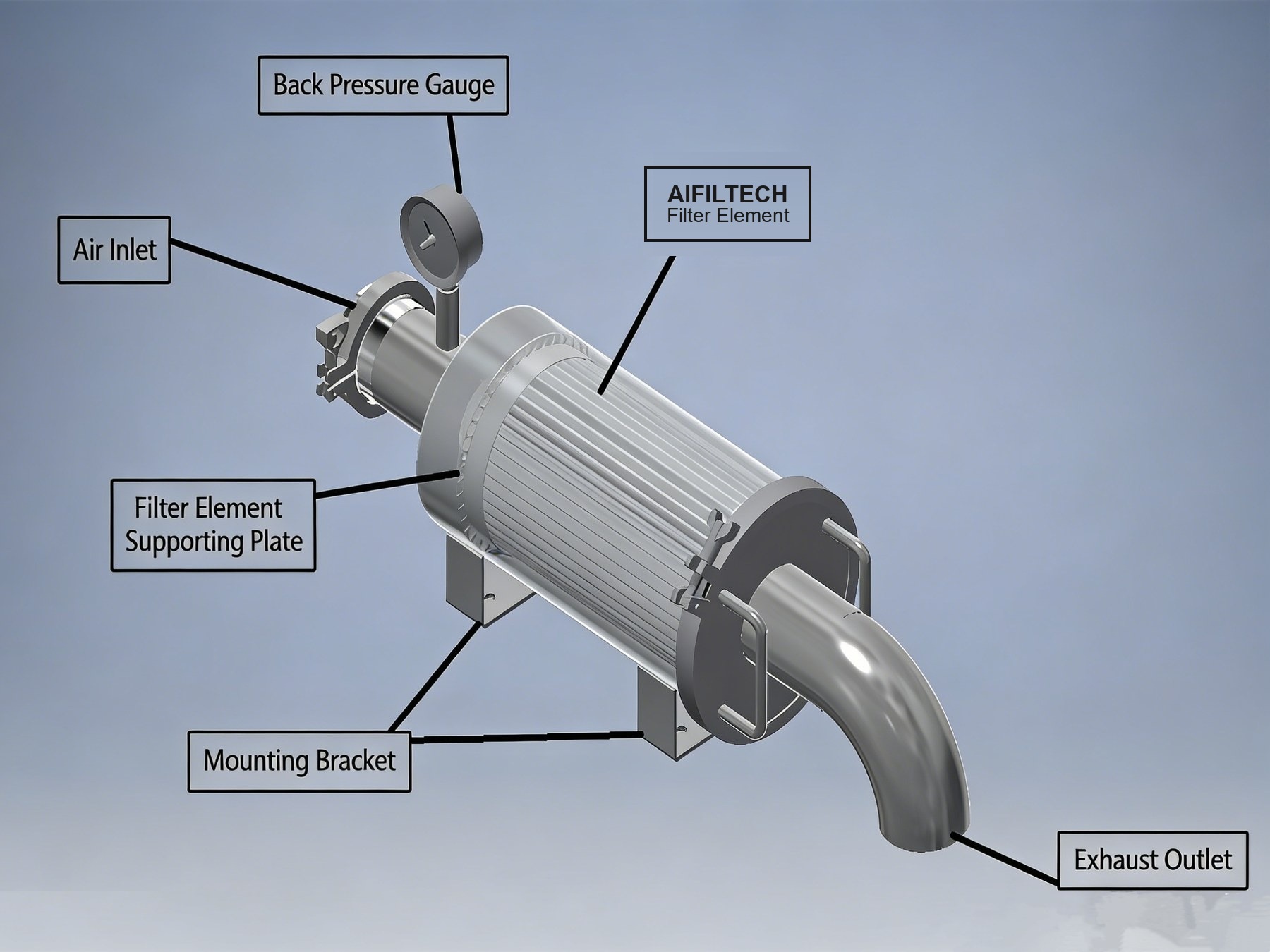
17. How does a metal DPF capture soot and particulate matter?
As diesel exhaust carrying soot and ash passes through the porous metal media, the soot and ash are physically intercepted by the three-dimensional network of micron-scale openings. The trapped soot and ash accumulate in the metal DPF until, usually judged by backpressure, the element is removed for cleaning and regeneration.
18. The stated filtration efficiency above 90%: on which engine, load and test conditions was it measured?
AIFILTECH metal exhaust purifiers are rated at more than 90% particulate filtration, and the figure comes mainly from measurements on old diesel engines after an AIFILTECH metal DPF was fitted. Across AIFILTECH’s several thousand units in service, measured particulate filtration has reached above 90%. Note that emission standards for diesel particulates do not use filtration efficiency as the compliance figure; they judge compliance by smoke.
19. Does filtration efficiency refer to particulate mass, particle number or exhaust smoke?
They are three different quantities and cannot stand in for one another. Mass efficiency is calculated from inlet and outlet mass concentration, number efficiency from number concentration; both are emission-concentration metrics. Smoke is an optical metric: opacity smoke is expressed as a light absorption coefficient (m⁻¹) and Ringelmann as a visual blackness grade. They differ in principle and in units and cannot be converted. Under GB 36886—2018 the Ringelmann and opacity methods are two separate test methods, either of which can on its own establish an exceedance, and Ringelmann is not a precondition for opacity (MEE reply of 3 December 2021). That reply only settles which enforcement method applies; it provides no basis for converting between smoke and PM mass or number efficiency. The relation between PM efficiency and smoke depends on particle size distribution, soot composition and duty, with no ready-made conversion, so a drop in smoke or a Ringelmann grade cannot replace PM mass or number efficiency. Quotes and acceptance must state the metric, unit, standard number and version, dry or wet basis, standard conditions, reference basis and test method.
20. Do new, used and freshly cleaned elements differ in efficiency?
Yes. A clean element shows the capture capability of the media itself. The particulate layer that builds up in service can improve fine-particle capture but raises backpressure. After regeneration or washing, residual soot, ash and a changed filter layer alter both efficiency and permeability. Compare efficiencies only with the same element pre-conditioning, load, test points and raw emissions.
21. What is the backpressure when clean and when loaded with soot?
There is no universal figure independent of model. At minimum, ask for the clean initial pressure drop, the typical operating range, the cleaning reminder value and the allowable maximum at a stated engine, speed, load and exhaust temperature. Soot raises backpressure, and piping and silencers add to the total. Ask for the backpressure curve rather than accepting a “low backpressure” label.
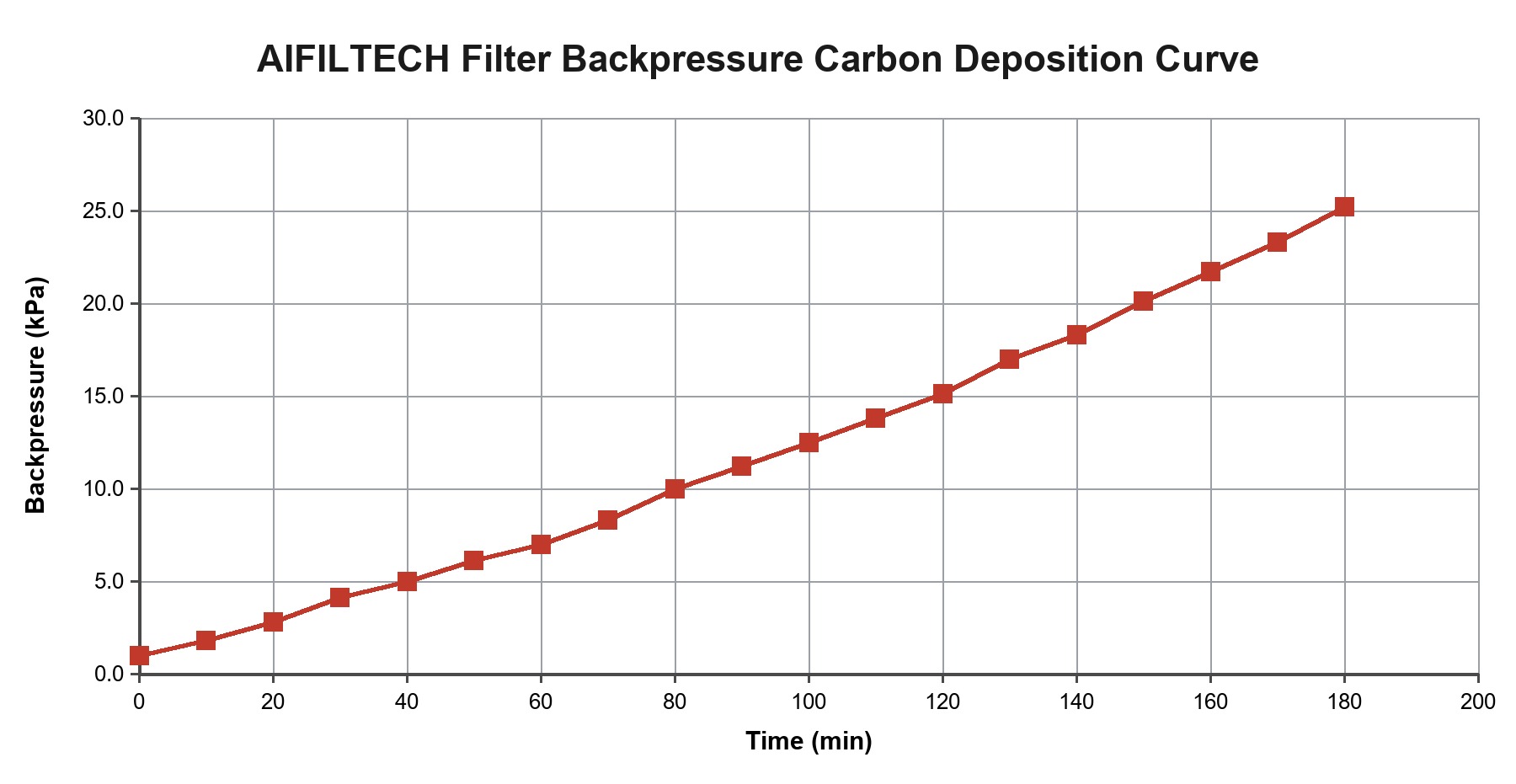
22. At what backpressure must it be cleaned? What happens if it is exceeded?
Under AIFILTECH’s current maintenance guide, schedule cleaning as backpressure approaches 25 kPa; running for long periods above 35 kPa risks element damage. Where the product manual or the engine maker’s limit is stricter, that value governs. Sustained high backpressure can cause power loss, higher fuel consumption, hard starting or structural damage to the element and must not be run through. Cleaning steps are in the metal DPF maintenance guide.
23. Will fitting a purifier cause power loss, higher fuel consumption or hard starting?
Any aftertreatment adds some exhaust restriction. With correct sizing and a clean element it stays within the engine’s allowance; heavy soot loading, an undersized unit or poor piping can cause power, fuel and starting problems. Across AIFILTECH’s several thousand units in service, engines have continued to run normally after a purifier was fitted.
24. How do I confirm the purifier’s backpressure has not exceeded the engine maker’s limit?
First obtain the engine manufacturer’s maximum allowable exhaust backpressure and its measuring-point requirement. Then measure backpressure upstream of the purifier and keep it below that limit.
25. How do metal and ceramic DPFs differ in use, regeneration, life and cost?
Metal elements are known for mechanical strength, thermal-shock resistance, washability and custom structures. Ceramic DPFs are a proven wall-flow capture route, but thermal stress, mounting and regeneration management matter just as much. Efficiency, regeneration and life for both depend on material, coating, duty and maintenance, so neither can be called longer-lived or cheaper across the board. Compare cleaning, spares, downtime and replacement cost. In the end it comes down to the diesel engine’s raw emissions and duty; the fit boundaries of the two routes are set out in metal washable DPF versus DOC + ceramic DPF.
26. Does an AIFILTECH metal element need a catalyst coating to work?
Not necessarily. An uncoated porous metal medium reduces particulates by physical capture on its own. A coating can oxidise certain gaseous pollutants or assist passive regeneration, but it brings temperature, fuel-sulfur and poisoning requirements. Whether a coating is needed depends on the target pollutants, exhaust temperature and regeneration route, and capture efficiency and catalytic function should be stated separately. Where there is no CO or HC limit to meet, the usual choice is no catalyst coating.
27. Does washing remove soot, ash or both?
A proper wash removes the soot deposited in the element, the portion of ash that can be carried off, and loose deposits. AIFILTECH DPFs can be cleaned of both soot and ash.
28. After long-term build-up of oil ash, is washing alone still enough?
Not always. Ash from oil additives, HC, wear and corrosion behaves differently from soot. Over time it takes up soot-holding capacity and raises backpressure, and AIFILTECH’s own hydrocarbon cleaning formulation may be needed to remove it completely.
29. What does high-sulfur fuel do to the element and to purification?
High-sulfur fuel does not affect the purification performance of an AIFILTECH DPF. In an SCR system, however, it raises the risk of sulfate particulates and acidic deposits and can affect the catalyst, the downstream SCR and backpressure, so sulfur must be limited especially in coated or SCR-equipped systems. International validation cases state their fuel-sulfur condition; some DPFs, for example, require 15 ppm sulfur. The figure for a given product is the one in its manual.
30. What failures come from high-sulfur diesel, poor-quality oil or long-term poor combustion?
In a DOC+SCR+DPF system these can cause acid corrosion or deposits, more sulfate particulates, catalyst deactivation, clogging by oil ash, faster soot build-up and abnormal backpressure. Long-term poor combustion can also leave unburned fuel, which is a safety risk when regeneration raises the temperature. Restore normal combustion and use fuel and oil that meet specification first, then assess cleaning or replacing aftertreatment parts.
31. What are the maximum continuous and instantaneous temperatures for the element?
Under AIFILTECH’s current metal DPF maintenance guide the continuous operating limit is 500 °C. The instantaneous peak cannot be derived from the continuous value; it must be set separately for the element material, coating, welds and casing. Over-temperature can cause oxidation, deformation, melt-through or loss of catalytic performance. For high-temperature engines AIFILTECH can supply an online monitoring system that tracks exhaust temperature, backpressure and other parameters in real time, with optional temperature and backpressure alarms.
32. Can an element be repaired after overheating, deformation or damage?
It should not be returned to service as a qualified element without assessment. Light external soiling can be washed off, but melt-through, visible deformation, cracked welds or a damaged filter layer can cause bypass leakage and structural failure. Take it out of service and replace it through the spares process.
33. How do I tell whether an element needs cleaning or is already damaged?
First look at whether backpressure rises steadily with running hours, then at appearance, sealing and service history. A sudden large drop in backpressure, or black smoke, points to a damaged element or seal and must be checked. Backpressure that keeps climbing, say to 25 kPa, means it is time to clean. In AIFILTECH’s experience a metal DPF fails in one way only: the owner does not clean it in time, the temperature rises and the accumulated soot ignites. Under normal use the elements last indefinitely. In low exhaust-temperature applications such as forklifts, there are known cases of owners running eight years without replacing an element.
34. How many times can a metal element be washed? When should it be replaced?
The number of washes cannot be guaranteed independently of fuel, ash, temperature, washing method and mechanical vibration; condition inspection replaces a simple count. Replacement is needed only when the element is damaged, melted through or otherwise beyond recovery. Recording backpressure and inspection results at each wash helps predict life.
35. Can metal elements be swapped between machines of different power ratings?
Only when element model, length, diameter, media grade, seal structure and temperature rating are all identical. A similar outline or a similar engine power is not enough. Units with different element counts may share the same single element or use different ones; mixing them changes flow distribution, backpressure and sealing. Check by part number.
36. Can spare elements be rotated in to reduce downtime?
Yes. Matching spare elements can be planned in: remove the dirty element, fit a clean one, and clean and dry the dirty one offline, so there is no waiting. Spare elements must carry the same part number as the originals and be stored dust-free, dry and protected from knocks. A washed element goes back into the spares pool only after it passes drying, visual and pressure-drop checks.
Related products and further reading
- Diesel Engine Exhaust Particulate Trap (Metal DPF) — Metal element material, sizes and mounting
- Road Vehicle Black Smoke Purifier — Model matching for trucks, buses and other road vehicles
- Non-road Vehicle Black Smoke Purifier — Fitment for forklifts, loaders, excavators, reach stackers and more
- DOC+DPF+SCR+ASC Exhaust Gas Purifier — The four-stage combination when NOx must be cut too
- Multi-core Metal Filter Dry Purifier — Multi-core dry configuration for generator exhaust
- Metal DPF Maintenance Guide — Washing steps, cleaning intervals and troubleshooting
- Metal Washable DPF vs DOC + Ceramic DPF — Fit boundaries of the two technical routes
- Forklift, Construction, Farm and Airport Vehicle Exhaust Purifier FAQ: 15 Questions — Fitting dimensions, salt-fog materials, cleaning intervals and inspection compliance
- DOC+DPF+SCR+ASC and Other Technology Routes: Purifier FAQ, 18 Questions — When SCR is required, the temperature window, urea and ammonia slip
Question not covered here? Send the engine model, rated power, exhaust pipe diameter and a photo of the machine, and we will run a sizing check on the figures first.
Bruce Wen · +86 188 1936 6808 (mobile / WhatsApp / WeChat) · bruce.wen@aifiltech.com