
DOC+DPF+SCR+ASC and Other Technology Routes: Purifier FAQ on Selection, Urea and Regeneration, 18 Questions
When does a NOx target make SCR mandatory? What does each of the DOC, DPF, SCR and ASC stages do? How wide is the effective SCR temperature window, and does urea still inject properly when the exhaust is cold? How big is the urea tank, and how is it kept from freezing? How is ammonia slip controlled? These 18 questions cover what users ask most often about selecting, controlling and maintaining DOC+DPF+SCR+ASC systems and the alternative technology routes. It sits alongside the diesel exhaust purifier FAQ: 36 questions, and the answers are based on AIFILTECH exhaust purification project documentation and field experience.
All 18 questions at a glance
- 1. When is SCR mandatory rather than just fitting a DPF?
- 2. What does each of the DOC, DPF, SCR and ASC stages remove?
- 3. Which duty cycles suit passive regeneration, and which suit active regeneration?
- 4. If passive regeneration is not enough, should heating or another active regeneration device be added?
- 5. Where do electrostatic precipitation and a filter-type DPF each fit, and what are their limits?
- 6. What is the effective SCR temperature window, and what happens at low temperature?
- 7. With long-term low-temperature, low-load running, how are urea injection and deNOx efficiency kept healthy?
- 8. Can an SCR system be designed before the engine-out NOx is known?
- 9. Does the system modify the engine’s original ECU?
- 10. How does the independent controller obtain exhaust temperature, NOx and differential pressure signals?
- 11. What urea solution is used, and how much of it, and how often is it topped up?
- 12. How large does the urea tank need to be, and how is it protected against freezing?
- 13. What alarms come up when the urea nozzle crystallises or clogs, or the pump fails?
- 14. How is ammonia slip controlled, and is it measured at acceptance?
- 15. Does high-sulfur fuel poison the catalyst, and how is that prevented?
- 16. How often does the catalyst need inspection or replacement?
- 17. Can each stage be removed, tested and replaced on its own?
- 18. Are sampling ports provided so inlet and outlet concentrations can be measured stage by stage?
1. Deciding on SCR: technology routes
1. When is SCR mandatory rather than just fitting a DPF?
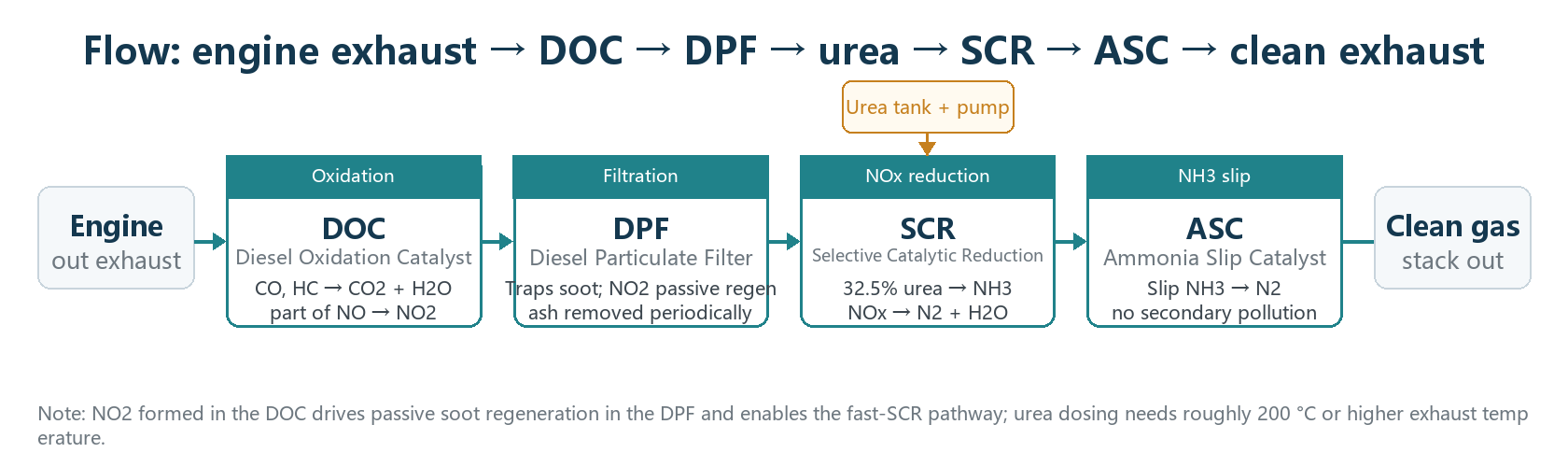
When the acceptance target includes a NOx reduction that engine adjustments alone cannot reach, an SCR or other deNOx route usually has to be assessed. A DPF on its own deals with particulate matter; it is no substitute for NOx control. Whether SCR is “mandatory” follows from the applicable standard, the engine-out NOx, the target limit and the exhaust temperature, and urea, control, ammonia slip and installation space all have to be budgeted at the same time. The configuration of the four-stage system is described on the DOC+DPF+SCR+ASC exhaust gas purifier page.
2. What does each of the DOC, DPF, SCR and ASC stages remove?
The DOC oxidises CO and HC and may shift the NO/NO₂ ratio; the DPF traps soot and ash particulate; the SCR uses ammonia to reduce NOx selectively; the ASC sits at the tail end and lowers excess ammonia slip. Each stage affects the temperature, backpressure and chemistry of the others, so single-stage efficiencies cannot simply be added together.
3. Which duty cycles suit passive regeneration, and which suit active regeneration?
Passive regeneration uses the heat and chemistry of the exhaust to oxidise soot continuously. It suits equipment whose exhaust temperature and duty are stable and whose regeneration conditions are met regularly. Active regeneration raises the temperature with electricity, a burner or other thermal management, which suits low-temperature or intermittent operation, but it adds energy use, control and safety requirements, so choose it with care. Commissioning in particular is challenging: there are plenty of cases where signal lag, a substrate that could not take the heat, overheating or over-injection burned the whole active regeneration system down.
4. If passive regeneration is not enough, should heating or another active regeneration device be added?
Where soot accumulates faster than passive regeneration can burn it, and removal-and-washing cannot keep up with the operating requirement, the answer is to assess an AIFILTECH purifier maintained by washing instead.
5. Where do electrostatic precipitation and a filter-type DPF each fit, and what are their limits?
A filter-type DPF traps particulate directly and needs regeneration or ash removal; its efficiency and backpressure behaviour are straightforward to manage. An electrostatic unit charges and collects the particulate, but with time the electrodes also have to be removed and washed. AIFILTECH once supplied a large share of the electrostatic precipitator electrodes on the market, mainly in Henan province, where they met the local emission-reduction route.
2. Temperature window and low-temperature duty
6. What is the effective SCR temperature window, and what happens at low temperature?
Three figures have to be kept apart. The SCR stage accepts urea injection over an exhaust temperature range of roughly 200-500 °C; that is the permitted injection range, not the high-efficiency band throughout. Urea is normally allowed to start injecting only above about 185-200 °C; below that, urea and ammonium nitrate deposits form readily, and below about 250 °C ammonium sulfate deposits can temporarily deactivate the catalyst. Mid-temperature catalysts such as vanadia-titania typically work at high efficiency from about 280-400 °C (some formulations to about 420 °C), while above roughly 450-500 °C side reactions and thermal ageing accelerate. The real window varies with catalyst formulation, space velocity, sulfur level and engine-out NOx. Formal figures must follow the specific catalyst curve and the worst-case load; the injection threshold is not the lower limit for efficient deNOx.
7. With long-term low-temperature, low-load running, how are urea injection and deNOx efficiency kept healthy?
High NOx removal cannot be promised at persistently low temperatures. Assess load management, insulation, exhaust temperature raise or safely designed active thermal management, and pause or limit urea injection by temperature to avoid crystall deposits; where necessary, change the installation position or the technology route. Acceptance testing must cover the usual low loads, not just the rated hot condition.
8. Can an SCR system be designed before the engine-out NOx is known?
Only a preliminary scheme, not a reliable final design. Engine-out NOx sets the reductant demand, catalyst volume, ammonia slip risk and running cost; temperature and flow at several loads and the NO₂ share are needed too. Before formal design, measure representative duty points, or obtain traceable data for the same engine model and agree a verification margin.
3. Control, urea and ammonia slip
9. Does the system modify the engine’s original ECU?
AIFILTECH’s DOC+DPF+SCR+ASC system uses an independent control unit to drive urea metering and injection. It does not modify the engine ECU, nor reflash or mask the engine’s fault codes; that is the technical route this combined system takes. Even with independent control, sensing, actuation and fault handling must not interfere with engine safety. If a project needs to read engine signals or interlock with the engine, the interface, access rights and lines of responsibility must be agreed in advance.
10. How does the independent controller obtain exhaust temperature, NOx and differential pressure signals?
Normally from exhaust temperature, NOx and differential-pressure sensors installed at the key positions, with speed or load information added where the assessment calls for it. Closed-loop NOx control also needs the upstream and downstream measuring points, sensor preheating and dew-point protection defined, and the differential-pressure impulse lines must be proof against blockage and condensation.
11. What urea solution is used, and how much of it, and how often is it topped up?
Vehicle SCR normally uses AUS 32 under the ISO 22241 system, a 32.5% urea-water solution; agricultural urea mixed on site is not acceptable. Consumption depends on engine-out NOx, exhaust flow, load and the target conversion, so a fixed ratio by power should not be quoted. The top-up interval follows from hourly consumption and usable tank volume, with margin for temperature and evaporation.
12. How large does the urea tank need to be, and how is it protected against freezing?
Tank volume follows the maximum urea consumption within the desired top-up interval, the space available and the expansion allowance, not engine power alone. AUS 32 can freeze at low temperature, so cold sites need insulation, heating and freeze-protected lines as the system design requires, and incompatible additives must be avoided. Thawing, materials and storage temperature should follow the urea supplier’s instructions.
13. What alarms come up when the urea nozzle crystallises or clogs, or the pump fails?
Depending on configuration, injection pressure, pump status, fluid level, temperature, NOx deviation or injection command versus actual response are monitored, with tiered alarms and a log. Crystallisation risk must be prevented through the injection threshold, shut-down purging and low-temperature control, not left to an alarm after the fault. The response to a fault, whether injection is limited or stopped and whether the equipment keeps running, has to be defined. The AIFILTECH SCR urea injection system purges residual urea solution automatically after injection stops, which reduces the risk of crystallisation as far as possible.
14. How is ammonia slip controlled, and is it measured at acceptance?
Ammonia slip is managed by the right NH3/NOx ratio, mixing, temperature window, injection control and the ASC together; under-injection lowers NOx conversion, over-injection raises slip. Whether it is measured at acceptance depends mainly on local emission regulations. Where it is measured, the measuring point, method, duty and limit are specified, and the high-conversion and low-temperature transient conditions are covered, not just one steady point.
4. Sulfur, catalyst life and maintenance
15. Does high-sulfur fuel poison the catalyst, and how is that prevented?
High sulfur increases sulfate deposits, loss of catalyst activity and particulate emissions, and the problem is worse at low temperature. Prevention means low-sulfur fuel that meets the system requirement, control of the temperature window, no long-term urea injection at low temperature, and a regeneration or replacement plan drawn from inspection results. Sulfur tolerance must be verified for the specific catalyst and duty.
16. How often does the catalyst need inspection or replacement?
A fixed number of years is not a good basis. Judge it from running hours, fuel sulfur, temperature history, backpressure, NOx/CO/HC conversion and the ammonia slip trend. Replacement is considered only when performance after cleaning or regeneration still fails the agreed figures, or when the catalyst is damaged or severely poisoned. The inspection interval can be adjusted after commissioning to match the real rate of degradation.
17. Can each stage be removed, tested and replaced on its own?
A modular design lets the DOC, DPF, SCR and ASC be maintained stage by stage, but flanges, supports, lifting gear and withdrawal space have to be allowed for, and sealing and gas direction checked on reassembly. Whether a stage can be replaced independently is also limited by casing structure, sensor positions and dimensions.
18. Are sampling ports provided so inlet and outlet concentrations can be measured stage by stage?
On customer request, sealable, accessible sampling ports that meet the test method can be provided before and after the key stages, to separate the performance and faults of the DOC, DPF, SCR and ASC. Port positions take mixing, straight pipe runs, temperature, safety and probe size into account; they cannot simply be cut into a bend or a dead zone. This is a custom feature, not a standard product.
Related products and further reading
- DOC+DPF+SCR+ASC Exhaust Gas Purifier — Configuration and specification of the four-stage system
- SCR Exhaust Gas Purifier — Temperature window and urea system of the SCR product
- Diesel Exhaust Purifier FAQ: 36 Questions on Sizing and Metal DPF — Route comparison and metal DPF principles
- Diesel Generator Exhaust Purifier FAQ: 22 Questions — Installation, bypass and cleaning downtime for fixed gensets
- Forklift, Construction, Farm and Airport Vehicle DPF FAQ: 15 Questions — Fitting dimensions and compliance for mobile machines
- Metal DPF Maintenance Guide — Washing steps, cleaning intervals and troubleshooting
A project that has to cut NOx and particulate together? Send the engine model, engine-out NOx if you have it, exhaust temperature at the usual loads and photos of the installation space, and we will first judge from the data whether the SCR route holds and how the catalyst volume should be sized.
Bruce Wen · +86 188 1936 6808 (mobile / WhatsApp / WeChat) · bruce.wen@aifiltech.com