
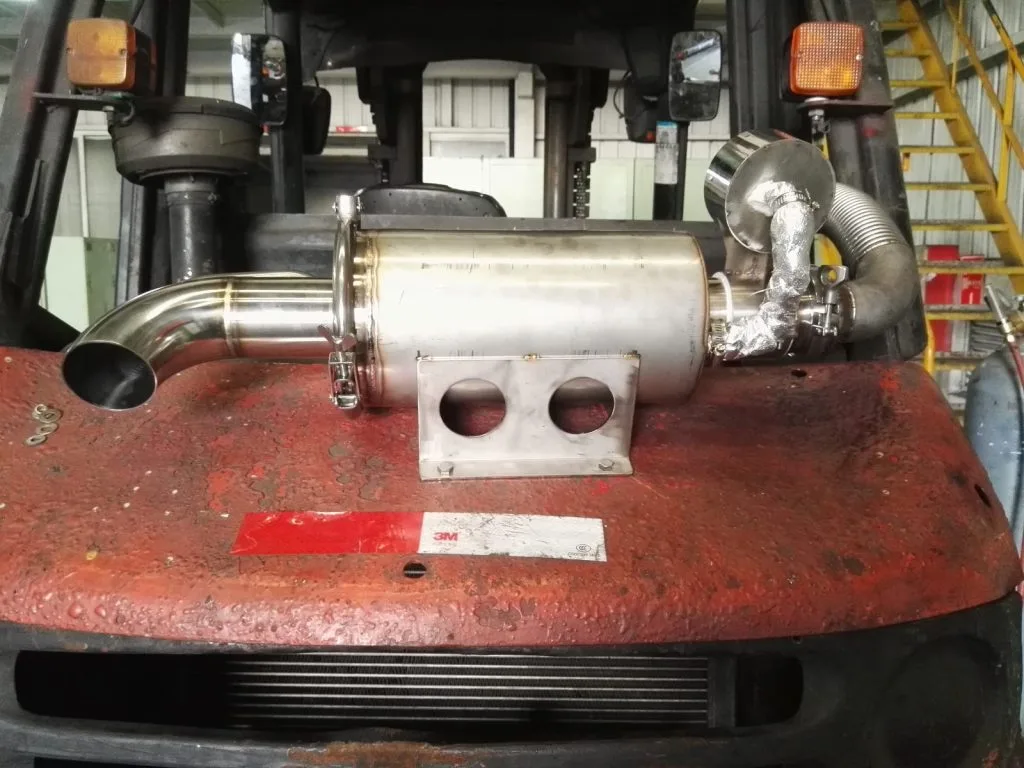
Forklift, Construction, Farm and Airport Vehicle DPF FAQ: 15 Questions
What has to be measured before a purifier goes on a forklift? Does a metal DPF still work on machines that idle for hours and never get hot? Which casing material suits salt fog at a port? What backpressure marks one cleaning cycle, and does fitting one affect the annual inspection or the engine warranty? These 15 questions are the ones users of forklifts, excavators, wheel loaders, farm machinery, port and airport vehicles ask most often about fitting, cleaning and compliance. It sits alongside the diesel exhaust purifier FAQ: 36 questions and the genset purifier FAQ: 22 questions, and the answers are based on AIFILTECH vehicle exhaust purification project documentation and field experience.
Jump to a question: every entry below links to its answer.
All 15 questions at a glance
- 1. Can a purifier be fitted directly to my forklift, excavator or wheel loader? What dimensions do you need?
- 2. Is a metal DPF still effective with long idling, low-speed work and low exhaust temperature?
- 3. Will fitting one reduce ground clearance or block the driver’s view?
- 4. Does the exhaust pipe have to be cut, brackets welded or the chassis modified?
- 5. Where else can the purifier go if the original silencer position cannot be used?
- 6. Will vibration, shock, dust and muddy water damage the purifier?
- 7. For ports and salt-fog sites, what material should the casing and element be?
- 8. Airport vehicles run rarely and idle a lot. How is the cleaning interval estimated?
- 9. During peak season there is no time for frequent cleaning. Can ash capacity be increased or spare elements kept?
- 10. What cleaning and storage steps are needed before farm machinery is parked for the season?
- 11. Different drivers use the machine every day. How do we stop cleaning being forgotten or parts being refitted wrong?
- 12. Will fitting one affect the engine warranty, the annual inspection or moving the machine to another site?
- 13. Can it be removed quickly and the original set-up restored for an inspection, repair or site move?
- 14. How do selection and compliance differ for road vehicles, non-road machines and marine engines?
- 15. Is there an installation case with the same brand, model and duty as mine?
1. Fitting dimensions and position
1. Can a purifier be fitted directly to my forklift, excavator or wheel loader? What dimensions do you need?
It is assessed per machine; brand or tonnage alone is not enough. Please send the engine nameplate, power and displacement, the size of the original silencer and exhaust pipe, the flange or clamp type, the available length, width and height, the direction the element is withdrawn, the counterweight and the space around it, the driver’s line of sight and the distance to hot parts. Wide and close-up photos with a tape measure in frame, plus running exhaust temperature and backpressure, matter just as much. For what to measure on each machine type, start with the non-road vehicle model reference.
2. Is a metal DPF still effective with long idling, low-speed work and low exhaust temperature?
Metal DPFs have a clear advantage on engines that idle for long periods, run at low speed and low load, or show low exhaust temperature. They are not only effective there; they are the first technical route to consider.
3. Will fitting one reduce ground clearance or block the driver’s view?
Ground clearance, the driver’s field of vision, the mast or working-tool envelope, turning circle and maintenance space are treated as hard limits, and the original silencer position or spare safe space is used first. The customer confirms the installation dimensions before production. “It fits” is not the test: collision, heat damage and counterweight balance all have to be checked.
4. Does the exhaust pipe have to be cut, brackets welded or the chassis modified?
The original silencer position with clamps or flanges is preferred to keep modifications down, but whether cutting or welding is needed depends on the pipe run, the space and the bracket conditions.
5. Where else can the purifier go if the original silencer position cannot be used?
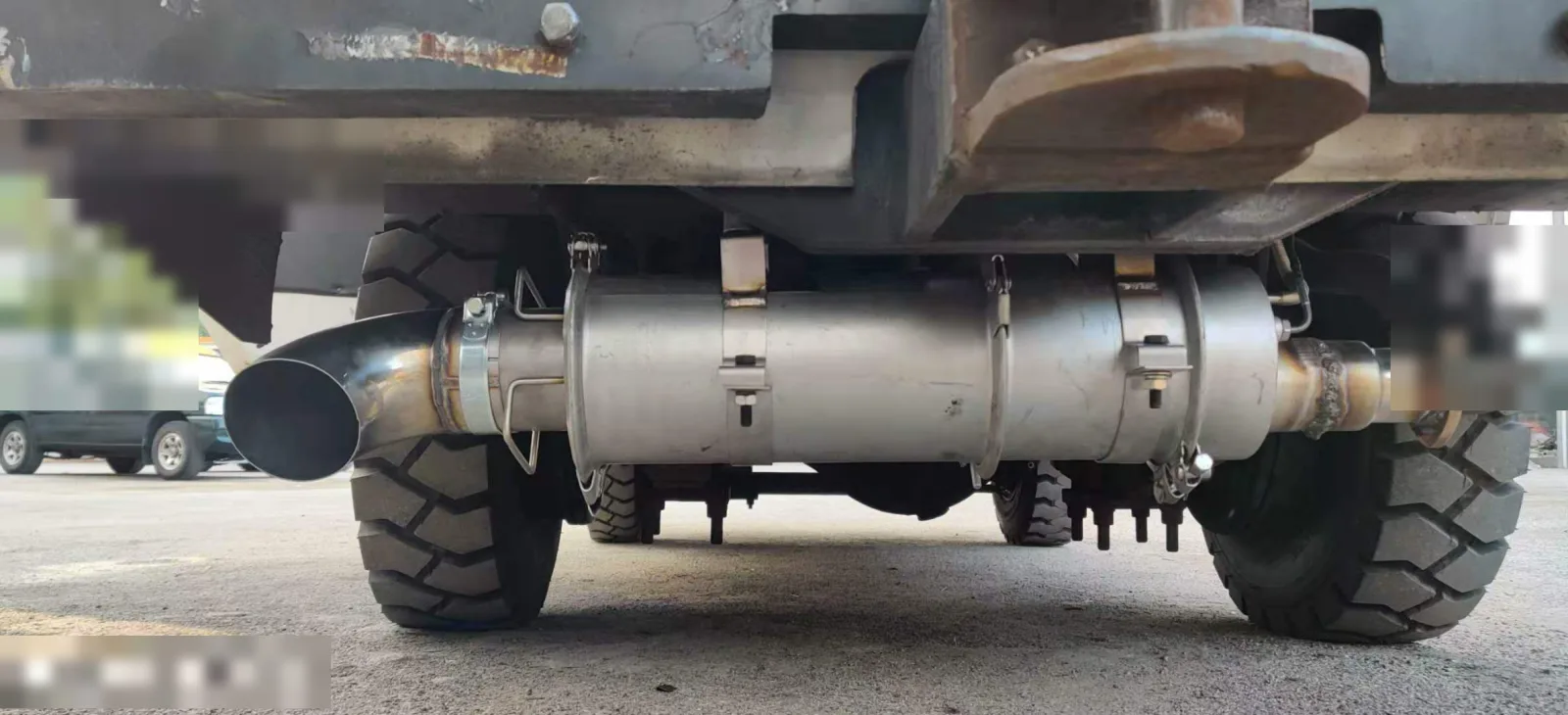
Options are along the exhaust run, at the rear of the machine, near the counterweight or on top where the structure has been confirmed. Each has to meet the requirements for exhaust temperature, backpressure, vibration, heat radiation, drainage, maintenance and collision protection. Keep it out of the driver’s walkway, away from flammable material and moving-part envelopes, and never where it blocks element withdrawal; the pipework and brackets may need redesign.
2. Harsh environments and materials
6. Will vibration, shock, dust and muddy water damage the purifier?
A harsh environment can lead to weld fatigue, loose elements, bracket cracks, sensor failure and surface corrosion. In AIFILTECH’s experience, however, metal DPFs keep working over long service in these conditions without failing.
7. For ports and salt-fog sites, what material should the casing and element be?
Material is chosen from salt fog, chloride level, exhaust temperature, condensing acids and washing frequency together; “stainless steel” on its own says too little. Compare suitable stainless grades or higher-alloy materials, external surface protection and isolation of fasteners, avoid standing water and dissimilar-metal galvanic couples, and check the final element material against temperature and welding process. AIFILTECH black smoke purifiers have a long record of successful use in port environments; the different constraints indoors and at the terminal are covered in the forklift and port tractor emissions application page.
3. Cleaning intervals and day-to-day management
8. Airport vehicles run rarely and idle a lot. How is the cleaning interval estimated?
Not by the calendar alone. Work from actual hours of use, and treat backpressure reaching 25 kPa as one cleaning cycle.
9. During peak season there is no time for frequent cleaning. Can ash capacity be increased or spare elements kept?
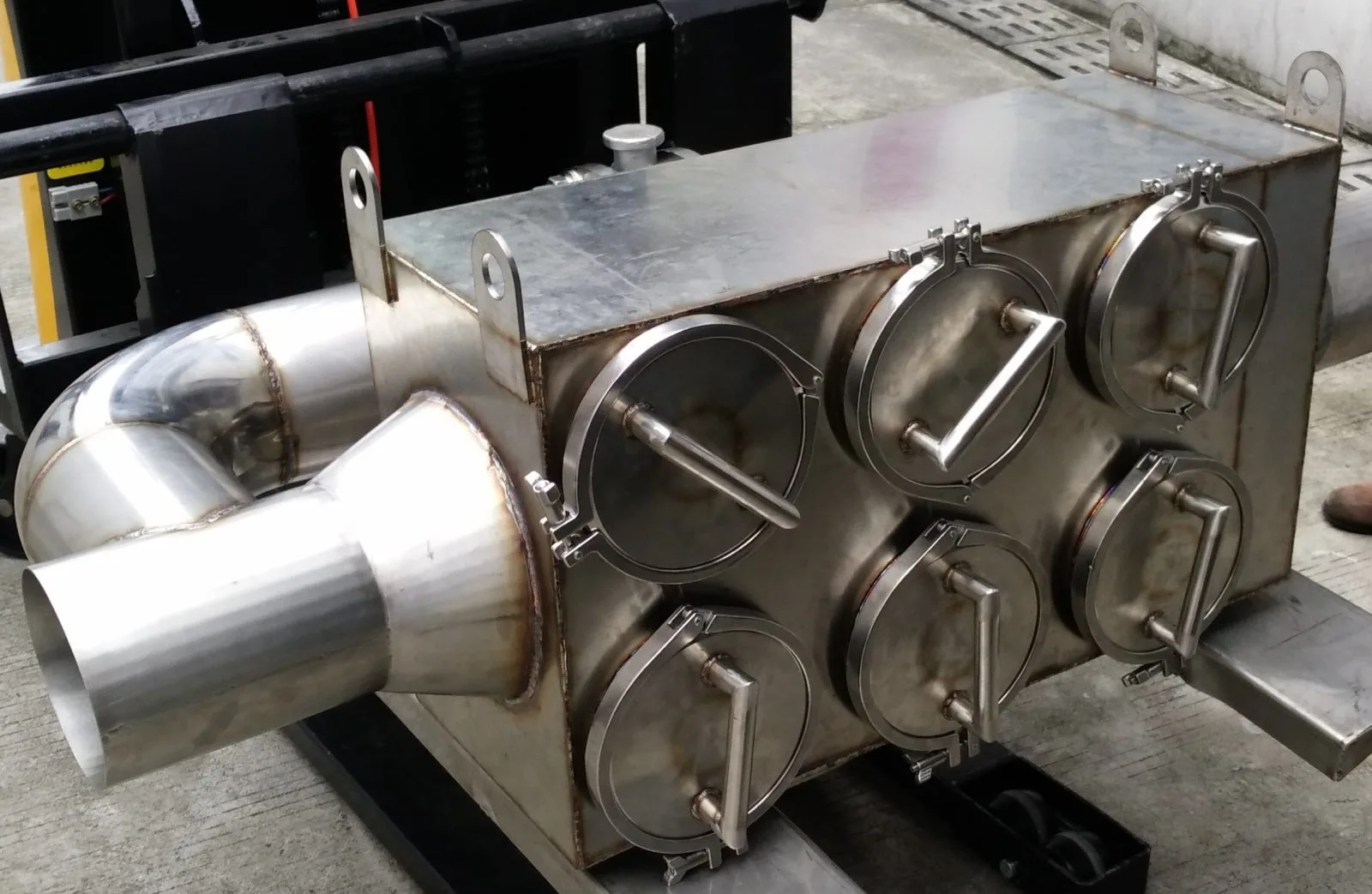
More effective filtration area and soot capacity, or spare elements of the same part number for quick swap-over, can both be assessed, but maintenance cannot be stretched without limit. A larger unit has to be checked for space, weight, backpressure and cost, and backpressure and alarms still have to be watched through the season so that running overloaded does not cause damage.
10. What cleaning and storage steps are needed before farm machinery is parked for the season?
Before parking, do the necessary washing under safe conditions, dry thoroughly and inspect the outside, removing standing water and wet soot sludge. Elements removed from the machine are stored sealed against dust, damp and impact; machine openings are plugged, but not so airtight that condensation forms. On recommissioning check sealing, corrosion, backpressure and engine condition, and record the readings before and after storage.
11. Different drivers use the machine every day. How do we stop cleaning being forgotten or parts being refitted wrong?
Put backpressure and alarms into the daily handover, give each element a part number and a direction mark, use standard clamps and fool-proof connections, and post a simplified procedure. Set different access levels for drivers, maintenance and management, and keep a cleaning and replacement log. Spare elements must be clearly marked “clean, ready to use” or “to be washed” so that the wrong one is never fitted.
4. Inspection, warranty and compliance
12. Will fitting one affect the engine warranty, the annual inspection or moving the machine to another site?
These are governed respectively by the engine maker’s warranty terms, local regulations and the inspection body’s requirements; a purifier supplier cannot by itself guarantee “no effect”. Obtain any confirmation the OEM or authority requires before installation, keep backpressure and structural safety within limits, and keep the selection, test and installation records. A removable design makes site moves or inspections easier, but must not be used to evade proper emission control.
13. Can it be removed quickly and the original set-up restored for an inspection, repair or site move?
A clamp, flange and independent-bracket design can be built for easy removal, with the original connections and fasteners kept for restoration. The actual time depends on access, cooling of hot parts and pipework complexity. Once removed, openings must be plugged, the unit stored properly and everything checked on refitting. Removal must never serve to get around legally required emission control.
14. How do selection and compliance differ for road vehicles, non-road machines and marine engines?
The three are governed by different regulations and inspection stages, and a report from one scenario cannot prove compliance in another. In use, non-road diesel mobile machinery and vehicle-mounted diesel equipment take the exhaust smoke test under GB 36886-2018, where either the Ringelmann or the opacity method may serve as the pass/fail basis on its own; road diesel vehicles in use follow GB 3847-2018 (free acceleration and lug-down, with OBD and NOx limits); marine engines follow GB 15097-2016 plus local and IMO requirements. New production and import approval follow GB 20891-2014 (China IV for non-road, from December 2022) and GB 17691-2018 (China VI for heavy-duty vehicles). Before selecting, confirm the target market, the equipment category and the test method applied locally, because a smoke test, a lug-down test and a free-acceleration test do not read the same number, then size and certify against that basis. Road vehicle fitment is in the road vehicle black smoke purifier section.
15. Is there an installation case with the same brand, model and duty as mine?
A case is comparable only when engine model, power, emissions stage, application, load and exhaust temperature all match, not just the look or the badge. AIFILTECH has a large number of vehicle and machine cases to compare against in the case library, but what matters most is the actual duty the vehicle or machine to be converted is in today.
Related products and further reading
- Non-Road Vehicle Black Smoke Purifier: Model Reference — Fitting conditions and selection checks for fifteen machine types
- Forklift Black Smoke Purifier — Washable type, the main model for indoor forklifts
- Excavator Black Smoke Purifier — Position and under-bonnet layout for excavators
- Wheel Loader Black Smoke Purifier — Loader models matched to smoke, CO and NOx
- Water-Washable Exhaust Purifier for Airport Vehicles — Models for airport ground vehicles
- Tractor Black Smoke Purifier (Farm Machinery DPF) — Exhaust temperature and seasonal use on farm machinery
- Forklifts and Port Tractors: Two Duty Cycles — How space, heat, salt and idling constrain the choice
- Road Vehicle Black Smoke Purifier — Model matching for road diesel vehicles
- Diesel Exhaust Purifier FAQ: 36 Questions on Sizing and Metal DPF — The first 36 questions on sizing method and metal DPF
- Diesel Generator Exhaust Purifier FAQ: 22 Questions — Installation, bypass and cleaning downtime for fixed gensets
- DOC+DPF+SCR+ASC and Other Technology Routes: Purifier FAQ, 18 Questions — When SCR is required, the temperature window and the urea system
- Metal DPF Maintenance Guide — Washing steps, cleaning intervals and troubleshooting
Question not covered here? Send the machine type, engine model, an exhaust pipe photo and a photo of the available space with a tape measure, and we will run an installation check on the dimensions first.
Bruce Wen · +86 188 1936 6808 (mobile / WhatsApp / WeChat) · bruce.wen@aifiltech.com