Two awards set the schedule for the Mianyang No.3 waste-to-energy project in Jiangyou: main and auxiliary equipment, 153.2 million yuan, was fixed in September, and on November 7 the construction and installation contract went to PowerChina’s Chongqing branch at 130.4 million yuan, with a 395-calendar-day schedule for the 750 t/d first phase. The flue gas route in the bid documents is blunt – SNCR in-furnace denitration, two dry acid-removal stages with lime and sodium bicarbonate, activated carbon injection, and a catalytic ceramic filter element to finish the job.
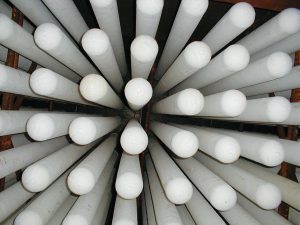
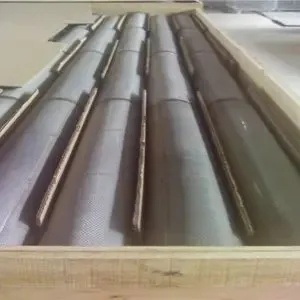
Set beside the conventional “baghouse plus standalone SCR plus wet scrubbing” train, the difference is not efficiency but process. The catalytic ceramic element puts surface filtration, SCR reaction and dioxin oxidation inside one tube; the standalone SCR reactor, gas reheat (SGH/GGH) and wet scrubber with its wastewater treatment all disappear. Flue gas enters the elements in a 240-280 degrees C window and leaves the stack at about 145 degrees C after an economizer. What is saved is capital, floor space, reheat steam and an entire wastewater system; what is put on the line is window control and element life.
Pilot-scale figures give a reference point: in a Zhejiang municipal-waste pilot, the process achieved 99.87 percent dust removal, 94.28 percent NOx reduction and about 95.7 percent dioxin decomposition (“Environmental Sanitation Engineering”, 2024, at 2,400 m3/h pilot conditions), and element life is quoted at 5-8 years against 2-3 years for conventional SCR catalysts. These are pilot numbers, not guarantees for a 750 t/d commercial line.
One element doing three stages of work
Run the timeline forward: startup around 2028, then a first major element change-out around 2033 – two outage windows fewer than a 2-3 year SCR catalyst would demand, saving not just consumables but the generation lost in every change-out. As ultra-low emission requirements reach new incineration projects, process design is shifting from stacking equipment to merging it. The same logic runs through high-temperature flue gas: AIFILTECH builds its ceramic fiber filter tubes on the same one-vessel principle – dust cake on the outer wall, catalytic denitration on the inner – rated to 1,600 degrees C for glass kilns and coking plants, while applications that need washable, hydrolysis-resistant media go to metal filter bags. The Jiangyou line’s continuous-run data will be worth watching across the industry.