
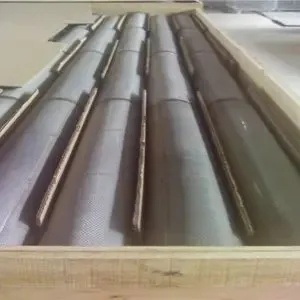
Metal Filter Bags, Cartridges and Sintered Metal Media: Materials, Accuracy and Cleaning, 31 Questions
These 31 questions cover the topics buyers raise most often about metal filter bags, cartridges and sintered metal media. Answers are based on AIFILTECH product documentation, maintenance guides and field experience, and sit alongside the main FAQ hub and the companion guides in this series. Technical values are governed by the model test report and the signed technical agreement.
All 31 questions at a glance
- 1. Metal filter bag or ceramic fibre filter tube: how to choose?
- 2. What is the structural and application difference between metal filter bags, cartridges and tubes?
- 3. Which equipment suits cylindrical, pleated and flanged designs?
- 4. How to choose between 316L, 310S, FeCrAl, titanium, nickel and Hastelloy?
- 5. What are the long-term and peak temperatures for different materials?
- 6. Which material suits flue gas containing sulphur, chlorine, fluorine or high moisture?
- 7. Will metal filter bags fatigue or crack at welds when gas temperature changes frequently?
- 8. Is filtration accuracy nominal or absolute?
- 9. Can outlet emissions be judged from filtration accuracy alone?
- 10. Do metal filter bags support pulse-jet cleaning or offline water washing, and how to choose?
- 11. Do filtration accuracy and permeability change after cleaning?
- 12. Do metal filter bags need a cage, and how are they sealed?
- 13. How do we confirm that a replacement bag matches the old one dimensionally?
- 14. What are common failure modes of metal filter bags, and how are they inspected?
- 15. Can permeability, bubble point, pressure resistance and material test reports be provided?
- 16. How to choose between sintered fibre felt, sintered mesh and powder-sintered elements?
- 17. What is the difference between nominal and absolute filtration accuracy?
- 18. How to select media by medium, temperature, target accuracy and allowable pressure drop?
- 19. Why do media with the same accuracy differ in dirt holding and pressure drop?
- 20. How do porosity, permeability and bubble-point pressure affect use?
- 21. Can a full specification table be provided, not just typical parameters?
- 22. Can the media be made into sheets, cylinders, pleated elements, cones and discs?
- 23. Can interfaces, flanges, threads and seals be customised from an old part or drawing?
- 24. What are the maximum processable size and minimum order quantity?
- 25. Can a small sample be provided first for compatibility and pressure-drop testing?
- 26. Can elements be pulse-cleaned, backwashed, ultrasonically cleaned or chemically cleaned?
- 27. How do we judge whether an element has recovered after cleaning?
- 28. What are the compressive and fatigue data for elements at high temperature and pressure?
- 29. Are welds, end caps and the media made of the same corrosion-resistant material?
- 30. Can each batch be supplied with material certificates and factory test reports?
- 31. How is consistency of dimensions and performance ensured on repeat orders?
Metal filter bags, cartridges and tubes
1. Metal filter bag or ceramic fibre filter tube: how to choose?
Compare long-term and peak temperature, corrosive components, thermal shock, mechanical strength, cleaning method, filtration area and maintenance capability, not temperature alone. Metal filter bags are generally convenient for pulse cleaning and structural customisation; ceramic tubes suit higher temperatures or specific catalytic routes. Strong corrosion, halogens, or simultaneous treatment of several pollutants call for MULCERAFIL™ ceramic fibre filter tubes. Mild corrosion, no halide ions or pitting environment, dust removal only, moderate temperature and a need for a large filtration area per element favour metal filter bags. Metal filter bags must not be used where HF is present.
2. What is the structural and application difference between metal filter bags, cartridges and tubes?
A metal filter bag emphasises a flexible or formed bag body installed in a tube sheet, suited to gas-solid filtration and pulse cleaning. A cartridge is usually a rigid cylinder or pleated structure, increasing area with an end connection. A filter tube generally means a tubular filter element for gas or liquid, with a wider range of connections and strength designs. These names are not governed by a single standard, so procurement should follow the structural drawing, dimensions and duty. In most purchasing contexts the three names refer to the same cylindrical metal filter bag.
3. Which equipment suits cylindrical, pleated and flanged designs?
Cylindrical designs are simple and easy to pulse-clean and wash. Pleated designs add filtration area within the same envelope, but need attention to dust accumulation between pleats and cleaning uniformity. Flanged describes the end connection rather than the media form, and suits equipment needing a reliable compressed seal. Check the tube sheet, pulse system, removal space and allowable pressure drop at the same time.
4. How to choose between 316L, 310S, FeCrAl, titanium, nickel and Hastelloy?
Consider oxidising or reducing atmosphere, continuous temperature, sulphur/chlorine/fluorine and acid-alkali corrosion, mechanical strength, thermal fatigue, weldability and cost together. 316L is not a universal answer for every high-temperature or chloride environment, and titanium and nickel should not be selected on corrosion reputation alone. Use a gas-composition and temperature matrix, with corrosion coupons where needed. Titanium, nickel and Hastelloy are rarely used in metal filter bags: material and processing costs are high, and welding, forming or high-temperature strength impose further limits.
5. What are the long-term and peak temperatures for different materials?
Temperature ranges differ by element and material. Long-term continuous operating temperatures for metal filter bags generally fall around 280–500 °C and must be confirmed item by item against material grade, atmosphere and thermal cycling. The temperature limit quoted on product pages is a short-term material or element limit, not a long-term continuous operating rating; the two must not be confused. A peak temperature also needs its allowable duration and frequency of occurrence.
6. Which material suits flue gas containing sulphur, chlorine, fluorine or high moisture?
There is no single best material independent of concentration and temperature. Chlorides with high moisture can intensify pitting and stress corrosion; sulphur forms acid corrosion near the dew point; fluorine attacks certain alloys and ceramics. Fluorine-containing gas must not be handled with metal filter bags where HF is present, and ceramic fibre filter tubes have a significantly shorter life in such service, so the replacement interval must be assessed first. Analyse dew point, condensation and wet-dry cycling first, then compare corrosion-resistant alloys, protective structures or upstream removal, and check weld and seal materials.
7. Will metal filter bags fatigue or crack at welds when gas temperature changes frequently?
Repeated thermal cycling can cause thermal fatigue, pleat deformation, weld cracks and loose seals. Risk depends on ramp rates, restraint, support, wall thickness and weld quality. The design should allow thermal movement and reduce local stress, with fatigue or thermal-shock verification against the actual cycling spectrum. Abnormal ramp rates should be controlled during operation.
8. Is filtration accuracy nominal or absolute?
Both terms must be defined. Nominal accuracy usually corresponds to a stated test particle size and efficiency condition; absolute accuracy should state the higher retention requirement and its test basis. Bubble-point pore size and mean-flow pore size are not the same as absolute filtration accuracy.
9. Can outlet emissions be judged from filtration accuracy alone?
No. Outlet emissions also depend on inlet concentration, particle size distribution, filtration velocity, dust cake, seal bypass, cleaning and the test method. The same media accuracy can give different outlet concentrations in different systems; conversely, a surface dust cake can raise efficiency. Project guarantees should state outlet concentration, duty and sampling method, and control leakage at the same time.
10. Do metal filter bags support pulse-jet cleaning or offline water washing, and how to choose?
Online pulse-jet cleaning suits continuous gas-solid systems, maintaining pressure drop by shedding the cake. Offline water washing suits duties where shutdown is acceptable, the ash can be safely removed, and wastewater and drying facilities exist. Sticky, hygroscopic, molten or catalyst-contaminated ash may need dedicated treatment. Choose by ash properties, operating regime and element construction, and verify performance after cleaning.
11. Do filtration accuracy and permeability change after cleaning?
They can. Cleaning may restore part of the permeability, but residual fine ash, chemical corrosion, mechanical damage or improper ultrasonic and high-pressure washing can alter pore structure and welds. After cleaning, retest permeability, integrity and, where needed, bubble point under the same medium, temperature and pressure drop. Visual cleanliness alone is not a pass criterion.
12. Do metal filter bags need a cage, and how are they sealed?
A conventional fabric-bag cage is not used; the support frame is welded to the metal filter media during manufacture as one assembly. Sealing may use flange compression, clamps, gaskets or a specific tube-mouth structure, allowing for thermal expansion and preventing bypass leakage. The final choice follows the interface drawing and pressure drop.
13. How do we confirm that a replacement bag matches the old one dimensionally?
Beyond overall length and outside diameter, measure the tube mouth, flange, seal groove, tube sheet hole and thickness, pleat or support structure, installation orientation and withdrawal space. Provide the old part, drawings and photos with a scale; trial-fit critical interfaces with a sample first. Using only the previous supplier model number instead of dimensional checks can cause leakage because of version differences.
14. What are common failure modes of metal filter bags, and how are they inspected?
Common failures include blocking and rising pressure drop, corrosion thinning, thermal fatigue, weld or pleat cracks, seal bypass, pulse damage and mechanical wear. Inspection should combine operating pressure drop, outlet dust, appearance, welds, dimensions and integrity testing. Once the failure location is found, analyse the underlying temperature, ash and cleaning causes.
15. Can permeability, bubble point, pressure resistance and material test reports be provided?
AIFILTECH metal filter bag media are tested for permeability, bubble point and pressure resistance during factory inspection, and a material test report can be provided on request.
Sintered metal media, elements and custom parts
16. How to choose between sintered fibre felt, sintered mesh and powder-sintered elements?
Sintered fibre felt has higher porosity with strong dirt-holding and depth-filtration capacity. Multi-layer sintered mesh is dimensionally stable with good support and backwash performance. Powder-sintered elements have a more uniform pore structure and high rigidity, suiting specific accuracy and high-pressure duties. The final choice combines medium, accuracy, pressure drop, temperature, cleaning and construction, not pore size alone.
17. What is the difference between nominal and absolute filtration accuracy?
Nominal accuracy is a grade defined by a stated retention rate (commonly 50%–95%, varying by maker) for a given particle size under specified test conditions. Absolute accuracy is defined by the filtration ratio beta from a multi-pass test (for example beta ≥75, or retention ≥98.7%, per ISO 16889:2022). Both need the efficiency, test dust and conditions stated. A 5 um rating from different makers is not directly comparable if the medium, flow and terminal pressure drop differ. Bubble point (ISO 4003) and permeability (ISO 4022) characterise pore size and flow, not absolute accuracy. Request the particle-size/efficiency curve, beta values and the standard used; for hot-gas filter elements, confirm whether the method applies rather than carrying over hydraulic-oil filter data.
18. How to select media by medium, temperature, target accuracy and allowable pressure drop?
First confirm medium composition, viscosity or density, corrosiveness, continuous and peak temperature. Then set the media grade from the target particle size and efficiency, size the area from maximum flow and allowable clean/terminal pressure drop, and finally check strength, sealing and cleaning. Data for hot gas and ambient liquid must not be mixed; validate in the actual medium wherever possible.
19. Why do media with the same accuracy differ in dirt holding and pressure drop?
The same nominal accuracy does not mean the same pore-size distribution, thickness, porosity, fibre or particle structure. High porosity and graded structures provide more dirt-holding volume, and surface and depth filtration block pores differently. Medium, flow and particle shape also change pressure-drop growth. Comparisons should use the same test dust, flow and terminal pressure drop.
20. How do porosity, permeability and bubble-point pressure affect use?
Porosity is the void volume fraction and affects dirt holding and strength. Permeability is the flux under a specified medium and pressure drop and relates to initial energy use. Bubble point assesses the largest connected pore and integrity. The three are related but not interchangeable; none alone gives filtration efficiency. Use them together with pore-size distribution, thickness and measured efficiency.
21. Can a full specification table be provided, not just typical parameters?
Yes. Such a specification covers material grade, dimensions and tolerances, accuracy definition, porosity, permeability, bubble point, flow/pressure-drop curves, continuous and peak temperatures, allowable pressure drop, connections and cleaning limits, and distinguishes guaranteed from typical values. Because it is highly technical, it is not listed on the website; the complete table is available on request.
22. Can the media be made into sheets, cylinders, pleated elements, cones and discs?
Sintered metal media can generally be formed into several shapes, but minimum bend radius, pleat height, welding distortion and size capability differ by media. Provide drawings, working pressure drop and sealing requirements before customisation, and evaluate effective area, dead zones, cleaning and manufacturability. Do not assume every shape retains the original media performance.
23. Can interfaces, flanges, threads and seals be customised from an old part or drawing?
Customisation can be reviewed against a confirmed old part or drawing, provided the media grade, overall dimensions, interface standard, seal material, pressure and temperature are supplied. Old parts may be worn or distorted, so critical dimensions must be re-measured. Drawing revision, welding and inspection requirements are signed off before production, to avoid copying the outline while overlooking working performance.
24. What are the maximum processable size and minimum order quantity?
Maximum size is limited by raw material width, sintering equipment, forming and welding capability; minimum order quantity depends on material, tooling, slitting and batch size. There is no universal answer across the product range. Sheet, standard cylinders and non-standard shapes are quoted separately; oversized parts may be evaluated as welded assemblies, with weld strength, sealing and filtration uniformity checked. Please contact AIFILTECH sales to confirm dimensions. AIFILTECH has no minimum order quantity and supports non-standard customisation.
25. Can a small sample be provided first for compatibility and pressure-drop testing?
Small-sample validation is supported, especially for corrosive, high-viscosity, high-temperature or fine-particle duties. Samples and trial parts are supplied against a commercial quotation and charged as quoted. The business sequence is: purchase one unit for trial, re-test and confirm suitability, then move to long-term cooperation. Sample size, cost, lead time and any accompanying report are confirmed in the quotation.
26. Can elements be pulse-cleaned, backwashed, ultrasonically cleaned or chemically cleaned?
Common industry regeneration methods include online pulse cleaning, backwashing, ultrasonic cleaning and chemical cleaning, but applicability to our media and elements depends on material grade, construction, contaminant and cleaning agent, and follows the model data and tests. Pulse cleaning suits some dry ash; backwashing and ultrasonic cleaning suit contaminants that disperse safely; chemical cleaning first requires verification of corrosion and residue on the media, welds and seals. Any method should be trialled at small scale with controlled pressure, temperature and time, followed by a retest of pressure drop or permeability, and of bubble point and integrity where needed. Continue use only once the element is undamaged and back within the agreed range.
27. How do we judge whether an element has recovered after cleaning?
Check appearance and welds, dimensions, seals and integrity, then retest pressure drop or permeability under the same medium, temperature and flow as before cleaning. Retest bubble point and efficiency where needed. The criterion is recovery to the agreed range without damage, not weight or visual cleanliness, and not a return to brand-new initial values under every duty.
28. What are the compressive and fatigue data for elements at high temperature and pressure?
Data require the specific material, wall thickness, diameter, support, welds, temperature and direction of pressure drop; ambient media strength does not represent the whole element at high temperature. Compressive resistance should distinguish collapse, burst and allowable working pressure drop, and fatigue needs cyclic pressure drop, temperature and cycle count. Request whole-element testing or substantiated engineering calculations.
29. Are welds, end caps and the media made of the same corrosion-resistant material?
Not necessarily; each must be stated separately in the drawing and bill of materials. End caps, weld filler, supports and seals with lower corrosion resistance than the media can be the starting point of failure, and dissimilar metals can cause galvanic corrosion. Require material grades and welding procedures for every wetted or gas-contacting part to be compatible with the medium, not just for the media.
30. Can each batch be supplied with material certificates and factory test reports?
Specify in the order that each batch carries a material certificate, batch number, dimensional and visual inspection, and the necessary integrity and flow/pressure-drop reports, with the sampling ratio stated. Special projects can add spectroscopic material verification, weld or third-party inspection. Reports should trace to specific product numbers; generic copies that cannot be matched to a batch should be avoided.
31. How is consistency of dimensions and performance ensured on repeat orders?
Freeze the part number, signed drawing, material grade, media batch control, critical processes and acceptance methods. Subsequent orders reference the original technical agreement with first-article or batch re-verification. Any change in raw material, tooling, weld or accuracy is notified in advance and assessed for equivalence. Retained samples and original test data support long-term traceability.
Related FAQ guides and further reading
- Ceramic Fibre Filter Tubes and All-in-One Catalytic Tubes: Selection, Temperature Windows and DeNOx, 19 Questions
- High-Temperature Dust Collection Systems and EPC: Design, Explosion Protection and Acceptance, 32 Questions
- Titanium Felt, Nickel Felt and Porous Titanium Plate for Water Electrolysis: Selection, Contact Resistance and Life, 16 Questions
- Testing, Certification, Pricing, Lead Time and Export Purchasing: 26 Questions
- Installation, Training, Warranty, After-Sales and Maintenance: 30 Questions
- Diesel Exhaust Purifier FAQ: 36 Questions
- Diesel Generator Exhaust Purifier FAQ: 22 Questions
- Forklift, Construction, Farm and Airport Vehicle DPF FAQ: 15 Questions
- DOC+DPF+SCR+ASC and Other Technology Routes FAQ: 18 Questions
Need a model confirmed for your duty, or the technical documentation? Send the gas or engine parameters, target emissions and site conditions, and we will check the applicable model and acceptance basis against the data.
Bruce Wen · +86 188 1936 6808 (mobile / WhatsApp / WeChat) · bruce.wen@aifiltech.com